Question 2
Consider the family of initial-value problems Call a solution forward bounded if is bounded for .
Tasks
Find the roots and express the solution coefficients in terms of .
Determine exactly which initial slope produces a forward-bounded solution. State its limit.
Replace that slope by , where . Find when the growing and decaying terms have equal magnitude, and determine the eventual behavior.
For , calculate that time to three decimal places and sketch the perturbed and unperturbed solutions on . Explain why a small initial error can change the long-time conclusion.
Show solutionHide solution
Question 2 – Solution
Strategy. Express the initial data in the two modes and isolate the coefficient of the growing exponential.
Step 1: Resolve the data into modes. The characteristic polynomial is , so . From and , The nonzero root separation makes this data system invertible.
Step 2: Remove the growing mode exactly. If , the term dominates and . Thus forward boundedness holds exactly when , or . The selected solution is and tends to zero.
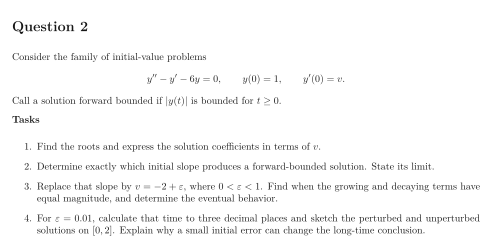
Step 3: Track a small slope perturbation. For , Both terms are positive. They are equal precisely when , giving This is positive for the stated range of . Eventually , although its initial slope is negative.
See the diagram in the original worksheet below.
Step 4: Quantify the delayed disagreement. For , . The exact difference is It vanishes initially and is small with on any fixed finite interval, but grows without bound as for every fixed positive . Forward boundedness here requires exact cancellation of a mode; it is not robust to a nonzero slope error. The time compares mode magnitudes and is not the time of the trajectory’s minimum.