Question 9
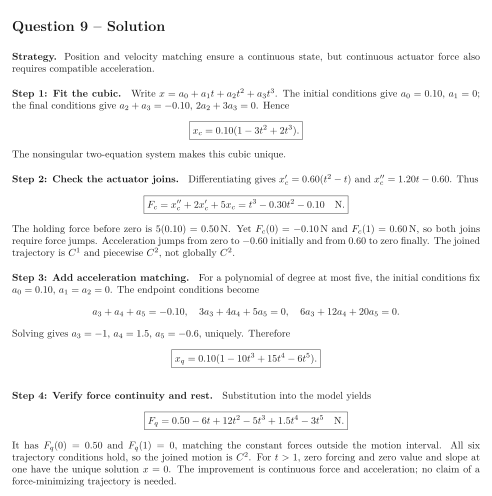
A mass with and obeys in SI units. An actuator must move it from , to , then turn off for . Before , it is held motionless at by a constant force.
Tasks
Find the unique cubic trajectory satisfying the four prescribed endpoint data on .
Compute its required force. Examine the force and acceleration when it joins the held state at zero and the rest state at one.
Instead require zero acceleration at both endpoints as well. Find the unique polynomial trajectory of degree at most five satisfying all six conditions.
Compute the new force and verify that it joins the pre-motion holding force and the zero post-motion force continuously. Show that the mass remains at rest after one second.
Show solutionHide solution
Question 9 – Solution
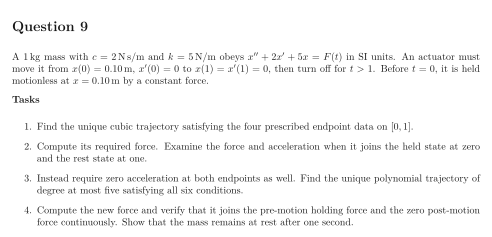
Strategy. Position and velocity matching ensure a continuous state, but continuous actuator force also requires compatible acceleration.
Step 1: Fit the cubic. Write . The initial conditions give , ; the final conditions give , . Hence The nonsingular two-equation system makes this cubic unique.
Step 2: Check the actuator joins. Differentiating gives and . Thus The holding force before zero is . Yet and , so both joins require force jumps. Acceleration jumps from zero to initially and from to zero finally. The joined trajectory is and piecewise , not globally .
Step 3: Add acceleration matching. For a polynomial of degree at most five, the initial conditions fix , . The endpoint conditions become Solving gives , , , uniquely. Therefore
Step 4: Verify force continuity and rest. Substitution into the model yields It has and , matching the constant forces outside the motion interval. All six trajectory conditions hold, so the joined motion is . For , zero forcing and zero value and slope at one have the unique solution . The improvement is continuous force and acceleration; no claim of a force-minimizing trajectory is needed.