Question 10
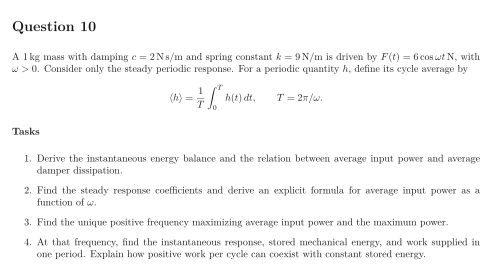
A mass with damping and spring constant is driven by , with . Consider only the steady periodic response. For a periodic quantity , define its cycle average by
Tasks
Derive the instantaneous energy balance and the relation between average input power and average damper dissipation.
Find the steady response coefficients and derive an explicit formula for average input power as a function of .
Find the unique positive frequency maximizing average input power and the maximum power.
At that frequency, find the instantaneous response, stored mechanical energy, and work supplied in one period. Explain how positive work per cycle can coexist with constant stored energy.
Show solutionHide solution
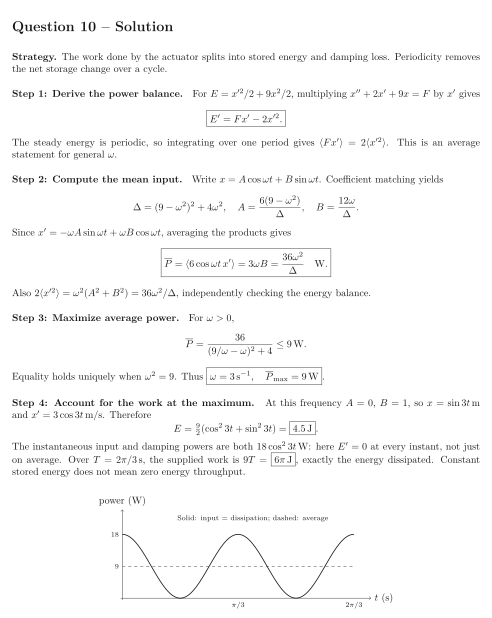
Question 10 – Solution
Strategy. The work done by the actuator splits into stored energy and damping loss. Periodicity removes the net storage change over a cycle.
Step 1: Derive the power balance. For , multiplying by gives The steady energy is periodic, so integrating over one period gives . This is an average statement for general .
Step 2: Compute the mean input. Write . Coefficient matching yields Since , averaging the products gives Also , independently checking the energy balance.
Step 3: Maximize average power. For , Equality holds uniquely when . Thus .
Step 4: Account for the work at the maximum. At this frequency , , so and . Therefore The instantaneous input and damping powers are both : here at every instant, not just on average. Over , the supplied work is , exactly the energy dissipated. Constant stored energy does not mean zero energy throughput.
See the diagram in the original worksheet below.