Question 3
A mass–spring–damper system has , and . It starts at equilibrium with velocity in the positive direction, with no external forcing. Define
Tasks
Find the displacement and velocity, including the damping regime.
Derive the energy balance directly from the equation. Does decreasing energy imply that must decrease from the start?
Find the first positive turning time, its displacement, and the energy dissipated up to that time.
Explain why at a turning point does not mean damping has ceased permanently. Find the total energy dissipated as .
Show solutionHide solution
Question 3 – Solution
Strategy. Track energy in both position and velocity. Displacement can grow while total mechanical energy falls.
Step 1: Solve the free motion. The equation is , with roots , so the motion is underdamped. The data give These expressions have , and residual zero.
Step 2: Derive the dissipation law. Multiplying the equation by gives Nevertheless, , so and initially increase from zero. Kinetic energy is partly converted into spring energy while the damper removes energy. Monotonic total energy is not monotonic displacement.
Step 3: Find the first turning point. The first root of satisfies , in . Set . Then The velocity changes from positive to negative, so this is a positive maximum. Initially . At the turning point,
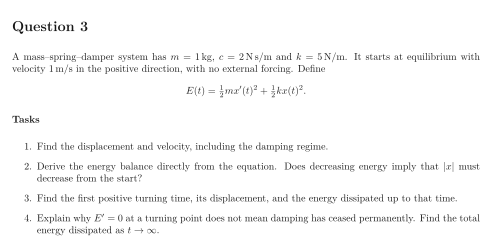
Step 4: Interpret zero instantaneous loss. At a turning point, , so damper power is instantaneously zero. But there and , so motion resumes immediately. The displayed response and velocity both tend to zero; hence and total dissipated energy is . In the figure, and both have velocity units, and .
See the diagram in the original worksheet below.