Question 2
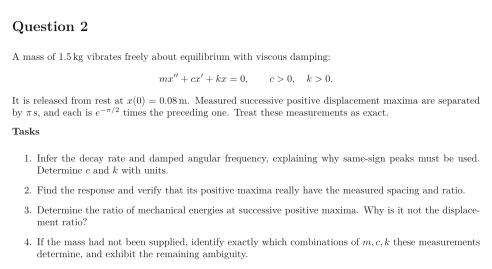
A mass of vibrates freely about equilibrium with viscous damping: It is released from rest at . Measured successive positive displacement maxima are separated by , and each is times the preceding one. Treat these measurements as exact.
Tasks
Infer the decay rate and damped angular frequency, explaining why same-sign peaks must be used. Determine and with units.
Find the response and verify that its positive maxima really have the measured spacing and ratio.
Determine the ratio of mechanical energies at successive positive maxima. Why is it not the displacement ratio?
If the mass had not been supplied, identify exactly which combinations of these measurements determine, and exhibit the remaining ambiguity.
Show solutionHide solution
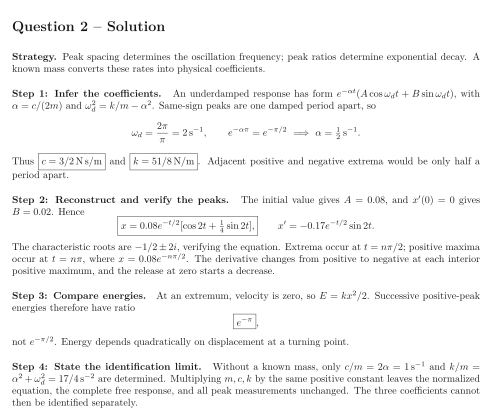
Question 2 – Solution
Strategy. Peak spacing determines the oscillation frequency; peak ratios determine exponential decay. A known mass converts these rates into physical coefficients.
Step 1: Infer the coefficients. An underdamped response has form , with and . Same-sign peaks are one damped period apart, so Thus and . Adjacent positive and negative extrema would be only half a period apart.
Step 2: Reconstruct and verify the peaks. The initial value gives , and gives . Hence The characteristic roots are , verifying the equation. Extrema occur at ; positive maxima occur at , where . The derivative changes from positive to negative at each interior positive maximum, and the release at zero starts a decrease.
Step 3: Compare energies. At an extremum, velocity is zero, so . Successive positive-peak energies therefore have ratio not . Energy depends quadratically on displacement at a turning point.
Step 4: State the identification limit. Without a known mass, only and are determined. Multiplying by the same positive constant leaves the normalized equation, the complete free response, and all peak measurements unchanged. The three coefficients cannot then be identified separately.