Question 1
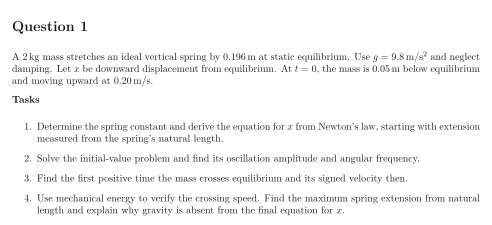
A mass stretches an ideal vertical spring by at static equilibrium. Use and neglect damping. Let be downward displacement from equilibrium. At , the mass is below equilibrium and moving upward at .
Tasks
Determine the spring constant and derive the equation for from Newton’s law, starting with extension measured from the spring’s natural length.
Solve the initial-value problem and find its oscillation amplitude and angular frequency.
Find the first positive time the mass crosses equilibrium and its signed velocity then.
Use mechanical energy to verify the crossing speed. Find the maximum spring extension from natural length and explain why gravity is absent from the final equation for .
Show solutionHide solution
Question 1 – Solution
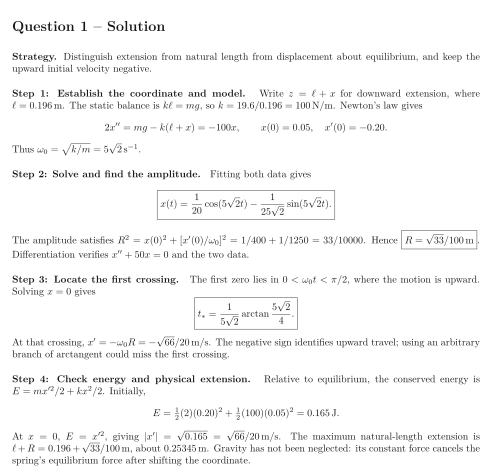
Strategy. Distinguish extension from natural length from displacement about equilibrium, and keep the upward initial velocity negative.
Step 1: Establish the coordinate and model. Write for downward extension, where . The static balance is , so . Newton’s law gives Thus .
Step 2: Solve and find the amplitude. Fitting both data gives The amplitude satisfies . Hence . Differentiation verifies and the two data.
Step 3: Locate the first crossing. The first zero lies in , where the motion is upward. Solving gives At that crossing, . The negative sign identifies upward travel; using an arbitrary branch of arctangent could miss the first crossing.
Step 4: Check energy and physical extension. Relative to equilibrium, the conserved energy is . Initially, At , , giving . The maximum natural-length extension is , about . Gravity has not been neglected: its constant force cancels the spring’s equilibrium force after shifting the coordinate.