Question 7
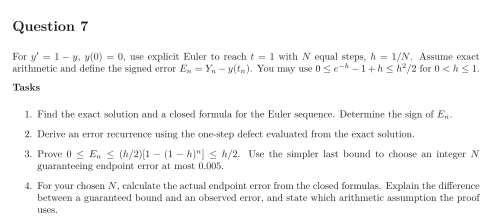
For , , use explicit Euler to reach with equal steps, . Assume exact arithmetic and define the signed error . You may use for .
Tasks
Find the exact solution and a closed formula for the Euler sequence. Determine the sign of .
Derive an error recurrence using the one-step defect evaluated from the exact solution.
Prove . Use the simpler last bound to choose an integer guaranteeing endpoint error at most .
For your chosen , calculate the actual endpoint error from the closed formulas. Explain the difference between a guaranteed bound and an observed error, and state which arithmetic assumption the proof uses.
Show solutionHide solution
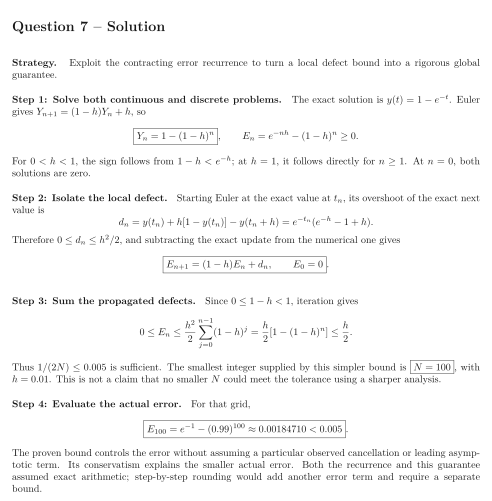
Question 7 – Solution
Strategy. Exploit the contracting error recurrence to turn a local defect bound into a rigorous global guarantee.
Step 1: Solve both continuous and discrete problems. The exact solution is . Euler gives , so For , the sign follows from ; at , it follows directly for . At , both solutions are zero.
Step 2: Isolate the local defect. Starting Euler at the exact value at , its overshoot of the exact next value is Therefore , and subtracting the exact update from the numerical one gives
Step 3: Sum the propagated defects. Since , iteration gives Thus is sufficient. The smallest integer supplied by this simpler bound is , with . This is not a claim that no smaller could meet the tolerance using a sharper analysis.
Step 4: Evaluate the actual error. For that grid, The proven bound controls the error without assuming a particular observed cancellation or leading asymptotic term. Its conservatism explains the smaller actual error. Both the recurrence and this guarantee assumed exact arithmetic; step-by-step rounding would add another error term and require a separate bound.