Question 6
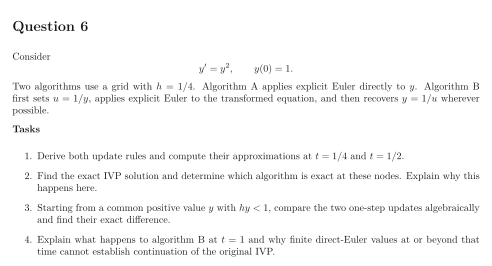
Consider Two algorithms use a grid with . Algorithm A applies explicit Euler directly to . Algorithm B first sets , applies explicit Euler to the transformed equation, and then recovers wherever possible.
Tasks
Derive both update rules and compute their approximations at and .
Find the exact IVP solution and determine which algorithm is exact at these nodes. Explain why this happens here.
Starting from a common positive value with , compare the two one-step updates algebraically and find their exact difference.
Explain what happens to algorithm B at and why finite direct-Euler values at or beyond that time cannot establish continuation of the original IVP.
Show solutionHide solution
Question 6 – Solution
Strategy. A nonlinear change of dependent variable preserves the exact differential equation but generally does not commute with a finite Euler step.
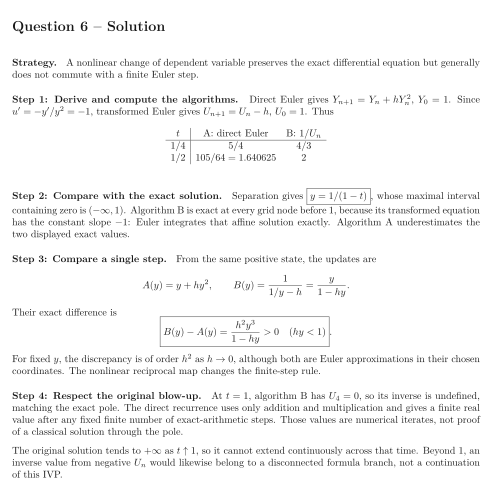
Step 1: Derive and compute the algorithms. Direct Euler gives , . Since , transformed Euler gives , . Thus
Step 2: Compare with the exact solution. Separation gives , whose maximal interval containing zero is . Algorithm B is exact at every grid node before , because its transformed equation has the constant slope : Euler integrates that affine solution exactly. Algorithm A underestimates the two displayed exact values.
Step 3: Compare a single step. From the same positive state, the updates are Their exact difference is For fixed , the discrepancy is of order as , although both are Euler approximations in their chosen coordinates. The nonlinear reciprocal map changes the finite-step rule.
Step 4: Respect the original blow-up. At , algorithm B has , so its inverse is undefined, matching the exact pole. The direct recurrence uses only addition and multiplication and gives a finite real value after any fixed finite number of exact-arithmetic steps. Those values are numerical iterates, not proof of a classical solution through the pole.
The original solution tends to as , so it cannot extend continuously across that time. Beyond , an inverse value from negative would likewise belong to a disconnected formula branch, not a continuation of this IVP.