Question 2
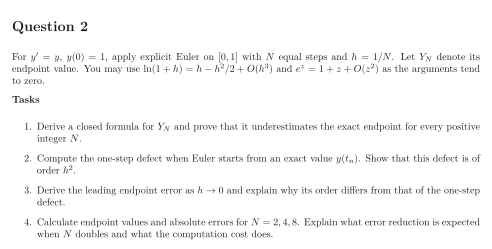
For , , apply explicit Euler on with equal steps and . Let denote its endpoint value. You may use and as the arguments tend to zero.
Tasks
Derive a closed formula for and prove that it underestimates the exact endpoint for every positive integer .
Compute the one-step defect when Euler starts from an exact value . Show that this defect is of order .
Derive the leading endpoint error as and explain why its order differs from that of the one-step defect.
Calculate endpoint values and absolute errors for . Explain what error reduction is expected when doubles and what the computation cost does.
Show solutionHide solution
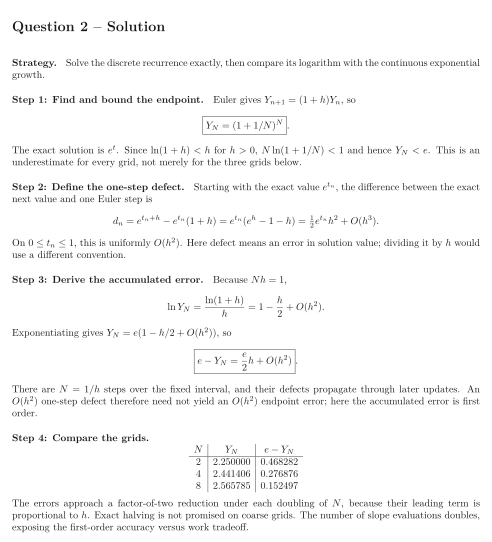
Question 2 – Solution
Strategy. Solve the discrete recurrence exactly, then compare its logarithm with the continuous exponential growth.
Step 1: Find and bound the endpoint. Euler gives , so The exact solution is . Since for , and hence . This is an underestimate for every grid, not merely for the three grids below.
Step 2: Define the one-step defect. Starting with the exact value , the difference between the exact next value and one Euler step is On , this is uniformly . Here defect means an error in solution value; dividing it by would use a different convention.
Step 3: Derive the accumulated error. Because , Exponentiating gives , so There are steps over the fixed interval, and their defects propagate through later updates. An one-step defect therefore need not yield an endpoint error; here the accumulated error is first order.
Step 4: Compare the grids. The errors approach a factor-of-two reduction under each doubling of , because their leading term is proportional to . Exact halving is not promised on coarse grids. The number of slope evaluations doubles, exposing the first-order accuracy versus work tradeoff.