Question 1
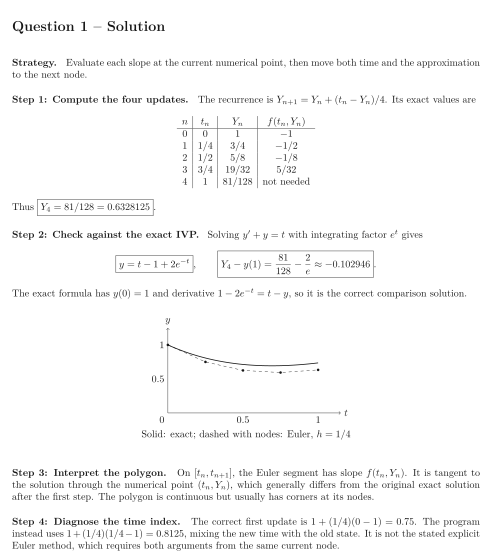
Consider For a step , explicit Euler uses and , where approximates . Use exact arithmetic in intermediate steps unless rounding is explicitly requested.
Tasks
Starting at , use to compute every Euler value through . Include the slope used on each step.
Find the exact solution and the signed endpoint error , reporting its numerical value to six decimal places.
Draw the Euler polygon and the exact solution on . Explain what the slope of each straight segment represents.
A program obtains by evaluating at . Identify the error and show the correct first update. Is that program implementing the stated Euler formula?
Show solutionHide solution
Question 1 – Solution
Strategy. Evaluate each slope at the current numerical point, then move both time and the approximation to the next node.
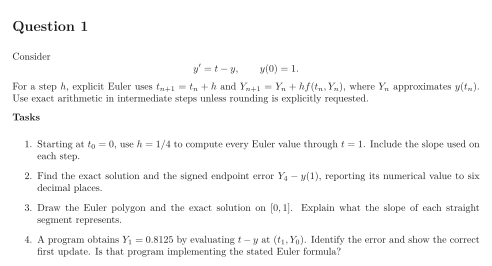
Step 1: Compute the four updates. The recurrence is . Its exact values are Thus .
Step 2: Check against the exact IVP. Solving with integrating factor gives The exact formula has and derivative , so it is the correct comparison solution.
See the diagram in the original worksheet below.
Step 3: Interpret the polygon. On , the Euler segment has slope . It is tangent to the solution through the numerical point , which generally differs from the original exact solution after the first step. The polygon is continuous but usually has corners at its nodes.
Step 4: Diagnose the time index. The correct first update is . The program instead uses , mixing the new time with the old state. It is not the stated explicit Euler method, which requires both arguments from the same current node.