Question 1
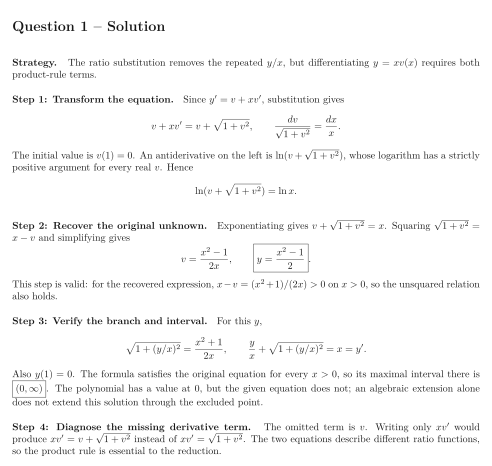
Consider the homogeneous first-order equation Here “homogeneous” means that the right-hand side depends only on ; it does not mean a homogeneous linear equation.
Tasks
Set and derive the equation for , showing the product-rule term in .
Solve the transformed IVP and recover an explicit formula for .
Verify the original equation, taking care with the nonnegative square root, and find the maximal interval within .
A student uses when . Identify the omitted term and explain why that error changes the transformed equation.
Show solutionHide solution
Question 1 – Solution
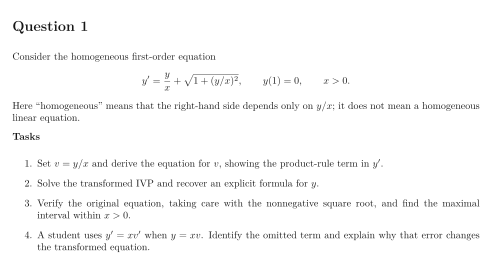
Strategy. The ratio substitution removes the repeated , but differentiating requires both product-rule terms.
Step 1: Transform the equation. Since , substitution gives The initial value is . An antiderivative on the left is , whose logarithm has a strictly positive argument for every real . Hence
Step 2: Recover the original unknown. Exponentiating gives . Squaring and simplifying gives This step is valid: for the recovered expression, on , so the unsquared relation also holds.
Step 3: Verify the branch and interval. For this , Also . The formula satisfies the original equation for every , so its maximal interval there is . The polynomial has a value at , but the given equation does not; an algebraic extension alone does not extend this solution through the excluded point.
Step 4: Diagnose the missing derivative term. The omitted term is . Writing only would produce instead of . The two equations describe different ratio functions, so the product rule is essential to the reduction.