Question 6
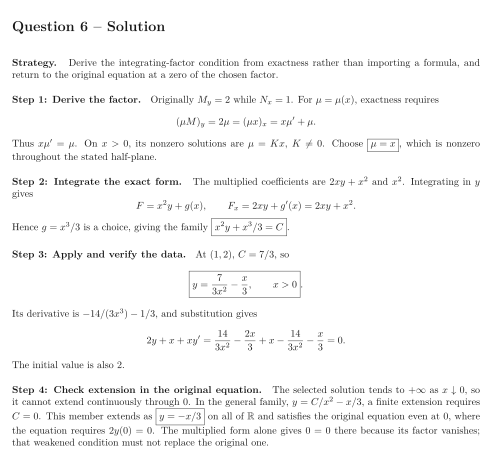
On the half-plane , consider An integrating factor is a nonzero function that makes a differential form exact when multiplied into both coefficients.
Tasks
Show that the original form is not exact. Derive, using the product rule, the condition on an integrating factor depending only on .
Find every such nonzero factor on , choose one, and construct a potential for the multiplied form.
Solve and verify the initial-value problem on .
Now consider the original equation on the whole plane. Decide whether the selected solution can extend through , and identify which member of the implicit solution family does extend differentiably through that point.
Show solutionHide solution
Question 6 – Solution
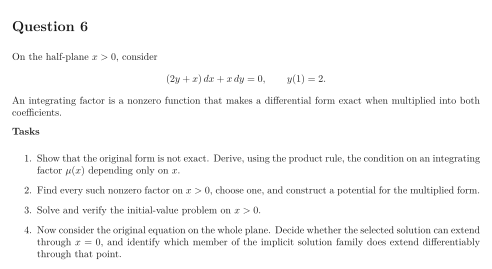
Strategy. Derive the integrating-factor condition from exactness rather than importing a formula, and return to the original equation at a zero of the chosen factor.
Step 1: Derive the factor. Originally while . For , exactness requires Thus . On , its nonzero solutions are , . Choose , which is nonzero throughout the stated half-plane.
Step 2: Integrate the exact form. The multiplied coefficients are and . Integrating in gives Hence is a choice, giving the family .
Step 3: Apply and verify the data. At , , so Its derivative is , and substitution gives The initial value is also .
Step 4: Check extension in the original equation. The selected solution tends to as , so it cannot extend continuously through . In the general family, , a finite extension requires . This member extends as on all of and satisfies the original equation even at , where the equation requires . The multiplied form alone gives there because its factor vanishes; that weakened condition must not replace the original one.