Question 5
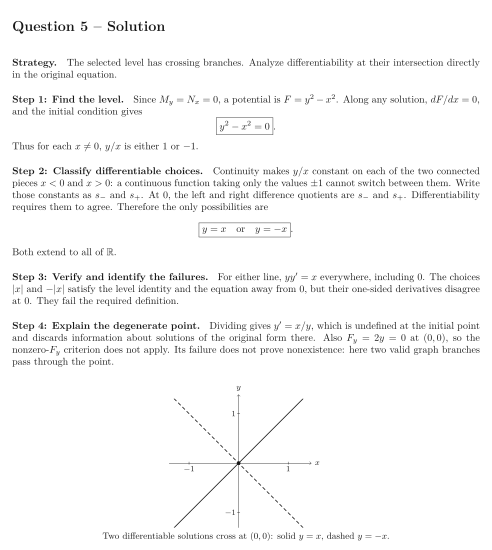
Consider the exact equation In this problem a solution means a real, continuously differentiable function on an open interval containing , satisfying at every point, including .
Tasks
Find a potential and the level selected by the initial condition.
Classify all solution graphs on such an interval. Justify why no additional sign-switching choices are differentiable at .
Check , , and against the stated definition.
Explain why neither division by nor the usual nonzero- implicit-function criterion settles the initial point.
Show solutionHide solution
Question 5 – Solution
Strategy. The selected level has crossing branches. Analyze differentiability at their intersection directly in the original equation.
Step 1: Find the level. Since , a potential is . Along any solution, , and the initial condition gives Thus for each , is either or .
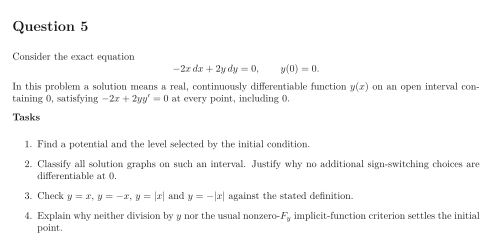
Step 2: Classify differentiable choices. Continuity makes constant on each of the two connected pieces and : a continuous function taking only the values cannot switch between them. Write those constants as and . At , the left and right difference quotients are and . Differentiability requires them to agree. Therefore the only possibilities are Both extend to all of .
Step 3: Verify and identify the failures. For either line, everywhere, including . The choices and satisfy the level identity and the equation away from , but their one-sided derivatives disagree at . They fail the required definition.
Step 4: Explain the degenerate point. Dividing gives , which is undefined at the initial point and discards information about solutions of the original form there. Also at , so the nonzero- criterion does not apply. Its failure does not prove nonexistence: here two valid graph branches pass through the point.
See the diagram in the original worksheet below.