Question 10
Design an affine coefficient in the separable equation so that one solution satisfies The constants and are real.
Tasks
Find and and justify why the three requirements determine them uniquely.
Find an explicit formula for the selected solution. You may use exponentials instead of hyperbolic functions.
Determine its maximal interval, every zero, its global maximum, and its limits as .
Verify the three requirements directly and list the constant solutions omitted when separating by .
Show solutionHide solution
Question 10 – Solution
Strategy. Use the zero terminal slope to constrain the coefficient, then use the separated integral to enforce the target height.
Step 1: Determine the coefficient. Since , forces . The smooth right-hand side gives local uniqueness, so the solution starting at cannot meet either constant solution . On its branch , At , this becomes . Hence These two independent linear conditions have exactly one pair of coefficients.
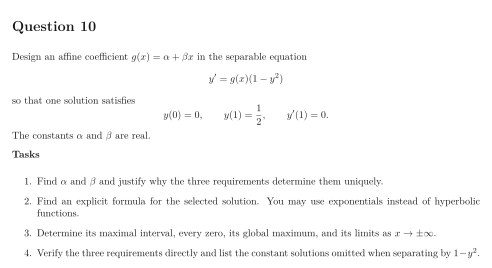
Step 2: Solve and interpret the curve. Set . Exponentiating and isolating gives Since , the formula is globally smooth and lies strictly between and . Its zeros are . The exponent has its unique maximum at , and increases with . Thus the unique global maximum is , while both limits at infinity are .
Step 3: Verify and restore constants. Here and , so . Also and verify both values and the zero slope. The omitted constants are ; neither satisfies .
See the diagram in the original worksheet below.