Question 9
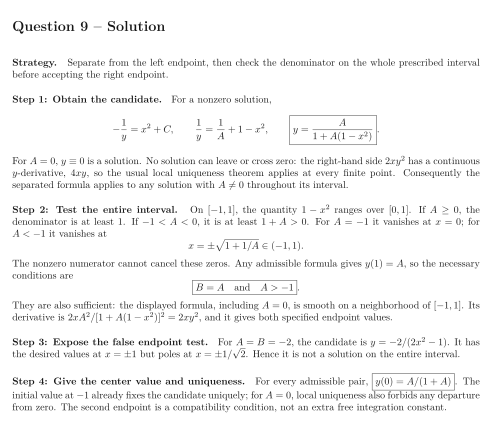
Let and be prescribed real numbers. Seek a real function that is continuously differentiable on and satisfies At the endpoints, derivatives are understood as one-sided derivatives.
Tasks
For , separate the equation and express the candidate solution in terms of . Also treat .
Determine all pairs for which a solution exists on the entire interval, and prove your conditions are sufficient as well as necessary.
Show why matching the two endpoint values in a formula does not by itself prove existence. Use as a test case.
For every admissible pair, find and decide whether the solution is unique.
Show solutionHide solution
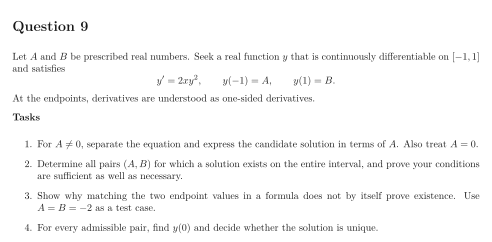
Question 9 – Solution
Strategy. Separate from the left endpoint, then check the denominator on the whole prescribed interval before accepting the right endpoint.
Step 1: Obtain the candidate. For a nonzero solution, For , is a solution. No solution can leave or cross zero: the right-hand side has a continuous -derivative, , so the usual local uniqueness theorem applies at every finite point. Consequently the separated formula applies to any solution with throughout its interval.
Step 2: Test the entire interval. On , the quantity ranges over . If , the denominator is at least . If , it is at least . For it vanishes at ; for it vanishes at The nonzero numerator cannot cancel these zeros. Any admissible formula gives , so the necessary conditions are They are also sufficient: the displayed formula, including , is smooth on a neighborhood of . Its derivative is , and it gives both specified endpoint values.
Step 3: Expose the false endpoint test. For , the candidate is . It has the desired values at but poles at . Hence it is not a solution on the entire interval.
Step 4: Give the center value and uniqueness. For every admissible pair, . The initial value at already fixes the candidate uniquely; for , local uniqueness also forbids any departure from zero. The second endpoint is a compatibility condition, not an extra free integration constant.