Question 4
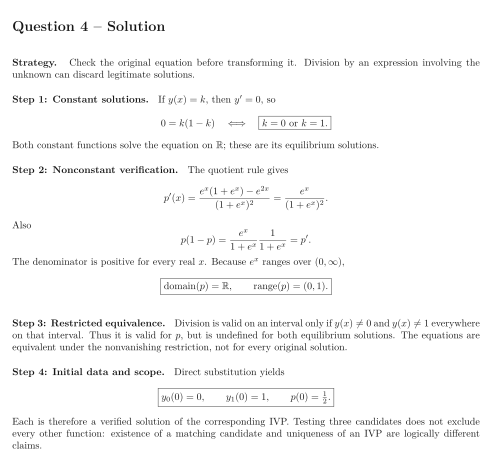
Consider A student divides by and claims that is an equivalent equation for every solution. The following functions are available for testing: Tasks
Find all constant solutions of the original equation.
Verify directly and state its domain and range.
Explain exactly when the division is valid and which listed solutions it excludes.
Match the initial values , , and to the listed candidates. Explain why this matching alone is not a proof of uniqueness among all possible solutions.
Show solutionHide solution
Question 4 – Solution
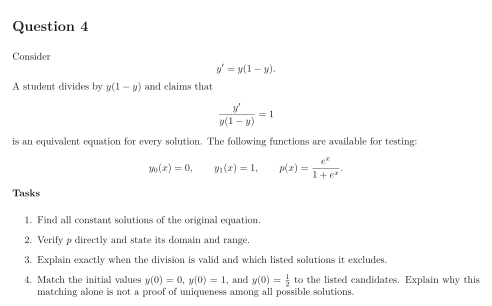
Strategy. Check the original equation before transforming it. Division by an expression involving the unknown can discard legitimate solutions.
Step 1: Constant solutions. If , then , so Both constant functions solve the equation on ; these are its equilibrium solutions.
Step 2: Nonconstant verification. The quotient rule gives Also The denominator is positive for every real . Because ranges over ,
Step 3: Restricted equivalence. Division is valid on an interval only if and everywhere on that interval. Thus it is valid for , but is undefined for both equilibrium solutions. The equations are equivalent under the nonvanishing restriction, not for every original solution.
Step 4: Initial data and scope. Direct substitution yields Each is therefore a verified solution of the corresponding IVP. Testing three candidates does not exclude every other function: existence of a matching candidate and uniqueness of an IVP are logically different claims.