Question 3
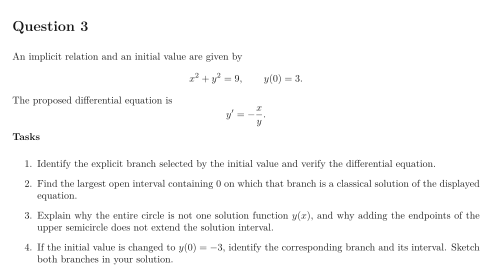
An implicit relation and an initial value are given by The proposed differential equation is Tasks
Identify the explicit branch selected by the initial value and verify the differential equation.
Find the largest open interval containing on which that branch is a classical solution of the displayed equation.
Explain why the entire circle is not one solution function , and why adding the endpoints of the upper semicircle does not extend the solution interval.
If the initial value is changed to , identify the corresponding branch and its interval. Sketch both branches in your solution.
Show solutionHide solution
Question 3 – Solution
Strategy. An implicit curve can contain multiple function branches. Select the branch using the initial value, then check both differentiability and the equation’s denominator.
Step 1: Select and verify. Solving for gives . Since , choose On this interval, , and .
See the diagram in the original worksheet below.
Step 2: Interval and endpoints. At , the branch has , so is undefined and the derivative is not finite. For , this branch is not real. Thus the largest open interval containing is exactly .
Step 3: Relation versus function. For each , the circle has two distinct -values. The whole circle fails the single-valued requirement for a function . Even the undivided equation cannot hold with a finite derivative at : it would require .
Step 4: Other initial value. For , Its derivative is , verifying the lower branch separately.
