Surface Integrals β€” Question 10

PDF β†—

Question 10

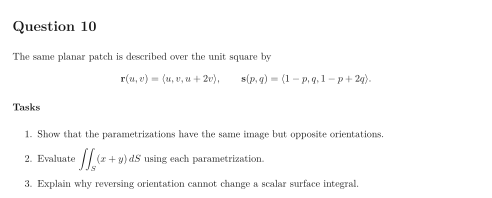
The same planar patch is described over the unit square by 𝒓(u,v)=⟨u,v,u+2v⟩,𝒔(p,q)=⟨1βˆ’p,q,1βˆ’p+2q⟩.\mathbf r(u,v)=\langle u,v,u+2v\rangle, \qquad \mathbf s(p,q)=\langle 1-p,q,1-p+2q\rangle.

Tasks

  1. Show that the parametrizations have the same image but opposite orientations.

  2. Evaluate ∬S(x+y)dS\displaystyle\iint_S(x+y)\,dS using each parametrization.

  3. Explain why reversing orientation cannot change a scalar surface integral.
Original worksheet page 1: question and worked solution for 6-3-010
Show solutionHide solution

Question 10 – Solution

Strategy. Recognize 𝒔(p,q)=𝒓(1βˆ’p,q)\mathbf s(p,q)=\mathbf r(1-p,q), then compare cross products by magnitude rather than sign.

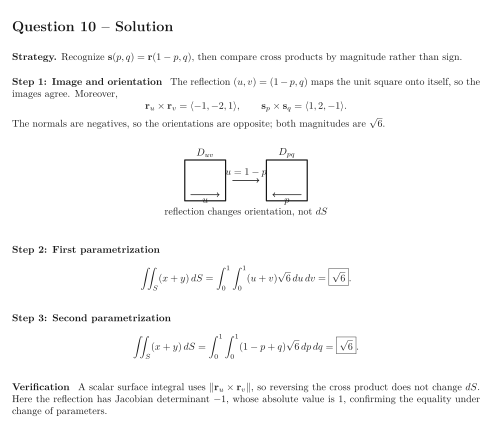
Step 1: Image and orientation The reflection (u,v)=(1βˆ’p,q)(u,v)=(1-p,q) maps the unit square onto itself, so the images agree. Moreover, 𝒓u×𝒓v=βŸ¨βˆ’1,βˆ’2,1⟩,𝒔p×𝒔q=⟨1,2,βˆ’1⟩.\mathbf r_u\times\mathbf r_v=\langle-1,-2,1\rangle, \qquad \mathbf s_p\times\mathbf s_q=\langle 1,2,-1\rangle. The normals are negatives, so the orientations are opposite; both magnitudes are 6\sqrt 6.

See the diagram in the original worksheet below.

Step 2: First parametrization ∬S(x+y)dS=∫01∫01(u+v)6dudv=6.\iint_S(x+y)\,dS =\int_0^1\int_0^1(u+v)\sqrt 6\,du\,dv =\boxed{\sqrt 6}.

Step 3: Second parametrization ∬S(x+y)dS=∫01∫01(1βˆ’p+q)6dpdq=6.\iint_S(x+y)\,dS =\int_0^1\int_0^1(1-p+q)\sqrt 6\,dp\,dq =\boxed{\sqrt 6}.

Verification A scalar surface integral uses ‖𝒓u×𝒓vβ€–\lVert\mathbf r_u\times\mathbf r_v\rVert, so reversing the cross product does not change dSdS. Here the reflection has Jacobian determinant βˆ’1-1, whose absolute value is 11, confirming the equality under change of parameters.
Original worksheet page 2: question and worked solution for 6-3-010

Original worksheet layout. Use Enlarge or open the PDF for a closer view.