Surface Integrals — Question 9

PDF ↗

Question 9

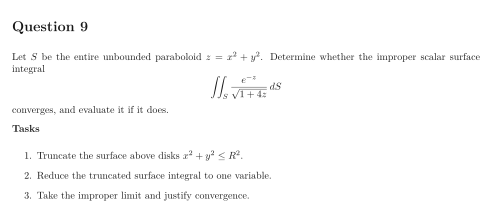
Let SS be the entire unbounded paraboloid z=x2+y2z=x^2+y^2. Determine whether the improper scalar surface integral ∬Se−z1+4zdS\iint_S\frac{e^{-z}}{\sqrt{1+4z}}\,dS converges, and evaluate it if it does.

Tasks

  1. Truncate the surface above disks x2+y2≤R2x^2+y^2\le R^2.

  2. Reduce the truncated surface integral to one variable.

  3. Take the improper limit and justify convergence.
Original worksheet page 1: question and worked solution for 6-3-009
Show solutionHide solution

Question 9 – Solution

Strategy. On this paraboloid, the denominator in the density is exactly the graph-area factor, leaving a Gaussian radial integral.

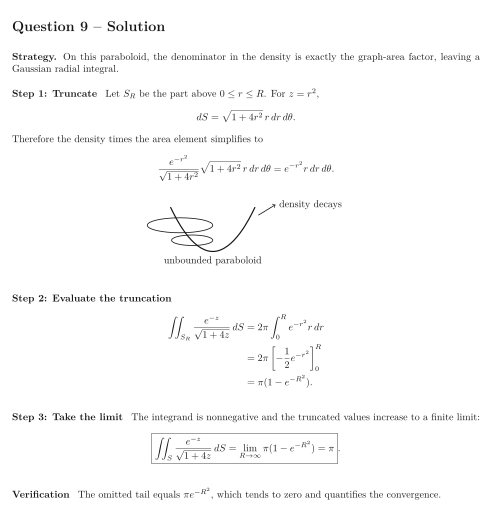
Step 1: Truncate Let SRS_R be the part above 0≤r≤R0\le r\le R. For z=r2z=r^2, dS=1+4r2rdrdθ.dS=\sqrt{1+4r^2}\,r\,dr\,d\theta. Therefore the density times the area element simplifies to e−r21+4r21+4r2rdrdθ=e−r2rdrdθ.\frac{e^{-r^2}}{\sqrt{1+4r^2}} \sqrt{1+4r^2}\,r\,dr\,d\theta =e^{-r^2}r\,dr\,d\theta.

See the diagram in the original worksheet below.

Step 2: Evaluate the truncation ∬SRe−z1+4zdS=2π∫0Re−r2rdr=2π[−12e−r2]0R=π(1−e−R2).\begin{align*} \iint_{S_R}\frac{e^{-z}}{\sqrt{1+4z}}\,dS &=2\pi\int_0^R e^{-r^2}r\,dr\\ &=2\pi\left[-\frac 12e^{-r^2}\right]_0^R\\ &=\pi(1-e^{-R^2}). \end{align*}

Step 3: Take the limit The integrand is nonnegative and the truncated values increase to a finite limit: ∬Se−z1+4zdS=limR→∞π(1−e−R2)=π.\boxed{\iint_S\frac{e^{-z}}{\sqrt{1+4z}}\,dS =\lim_{R\to\infty}\pi(1-e^{-R^2})=\pi}.

Verification The omitted tail equals πe−R2\pi e^{-R^2}, which tends to zero and quantifies the convergence.
Original worksheet page 2: question and worked solution for 6-3-009

Original worksheet layout. Use Enlarge or open the PDF for a closer view.