Question 2
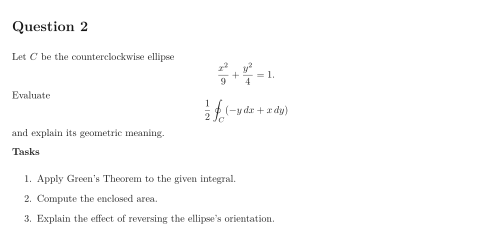
Let be the counterclockwise ellipse Evaluate and explain its geometric meaning.
Tasks
Apply Green’s Theorem to the given integral.
Compute the enclosed area.
Explain the effect of reversing the ellipse’s orientation.
Show solutionHide solution
Question 2 – Solution
Strategy. The chosen coefficients make , so the line integral measures area.
Step 1: Set and Write Then
See the diagram in the original worksheet below.
Step 2: Apply Green’s Theorem The ellipse has semiaxes and , so
Step 3: Reverse orientation Clockwise traversal negates the line integral, producing . Geometric area itself remains ; the sign records orientation.
Verification The area formula reduces to , and substituting , confirms .
