Question 1
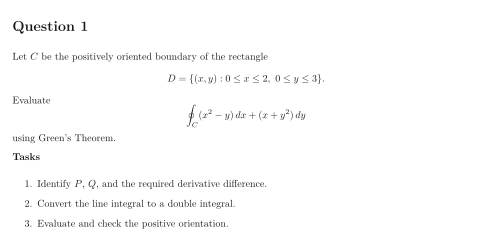
Let be the positively oriented boundary of the rectangle Evaluate using Green’s Theorem.
Tasks
Identify , , and the required derivative difference.
Convert the line integral to a double integral.
Evaluate and check the positive orientation.
Show solutionHide solution
Question 1 – Solution
Strategy. Apply the circulation form .
Step 1: Differentiate Here so
See the diagram in the original worksheet below.
Step 2: Integrate over the region
Step 3: Orientation Positive orientation means counterclockwise traversal, with the region on the left. That is the orientation for which Green’s Theorem gives the displayed positive sign.
Verification The derivative difference is the constant and the rectangle has area , so the value must be ; reversing would give .
