Question 8
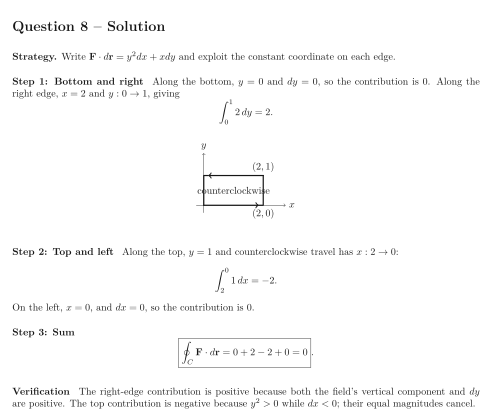
Let be the counterclockwise boundary of the rectangle , . For compute the circulation directly from the four edges.
Tasks
Compute each oriented edge contribution.
Add the four contributions.
Check which signs are forced by the traversal direction.
Show solutionHide solution
Question 8 – Solution
Strategy. Write and exploit the constant coordinate on each edge.
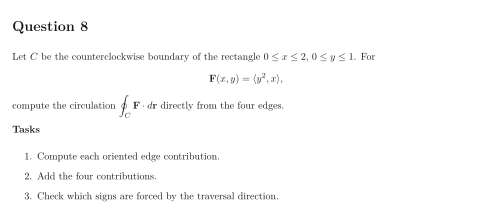
Step 1: Bottom and right Along the bottom, and , so the contribution is . Along the right edge, and , giving
See the diagram in the original worksheet below.
Step 2: Top and left Along the top, and counterclockwise travel has : On the left, , and , so the contribution is .
Step 3: Sum
Verification The right-edge contribution is positive because both the field’s vertical component and are positive. The top contribution is negative because while ; their equal magnitudes cancel.