Line Integrals of Vector Fields — Question 7

PDF ↗

Question 7

The field 𝑭(x,y)=⟨−y,x⟩\mathbf F(x,y)=\langle-y,x\rangle acts between A=(0,0)A=(0,0) and B=(1,1)B=(1,1). Compare the work along C1:𝒓(t)=⟨t,t⟩,0≤t≤1,C_1:\mathbf r(t)=\langle t,t\rangle,\quad 0\le t\le 1, and the broken path C2C_2 that goes from (0,0)(0,0) to (1,0)(1,0) to (1,1)(1,1).

Tasks

  1. Compute the work along C1C_1.

  2. Compute the work along both pieces of C2C_2.

  3. Explain what the comparison demonstrates.
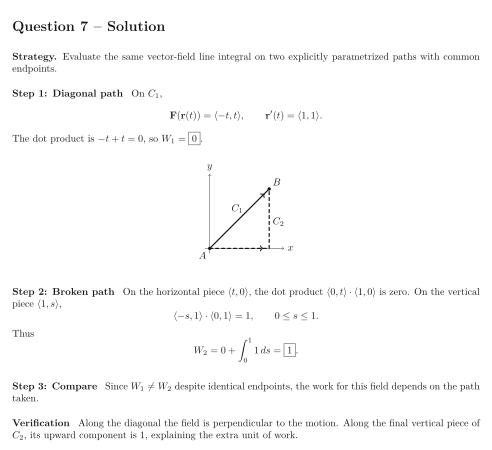
Original worksheet page 1: question and worked solution for 5-4-007
Show solutionHide solution

Question 7 – Solution

Strategy. Evaluate the same vector-field line integral on two explicitly parametrized paths with common endpoints.

Step 1: Diagonal path On C1C_1, 𝑭(𝒓(t))=⟨−t,t⟩,𝒓′(t)=⟨1,1⟩.\mathbf F(\mathbf r(t))=\langle-t,t\rangle,\qquad \mathbf r'(t)=\langle 1,1\rangle. The dot product is −t+t=0-t+t=0, so W1=0W_1=\boxed{0}.

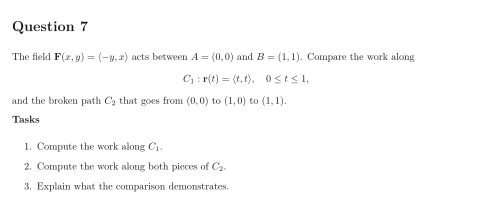
See the diagram in the original worksheet below.

Step 2: Broken path On the horizontal piece ⟨t,0⟩\langle t,0\rangle, the dot product ⟨0,t⟩⋅⟨1,0⟩\langle 0,t\rangle\cdot\langle 1,0\rangle is zero. On the vertical piece ⟨1,s⟩\langle 1,s\rangle, ⟨−s,1⟩⋅⟨0,1⟩=1,0≤s≤1.\langle-s,1\rangle\cdot\langle 0,1\rangle=1,\qquad 0\le s\le 1. Thus W2=0+∫011ds=1.W_2=0+\int_0^1 1\,ds=\boxed{1}.

Step 3: Compare Since W1≠W2W_1\ne W_2 despite identical endpoints, the work for this field depends on the path taken.

Verification Along the diagonal the field is perpendicular to the motion. Along the final vertical piece of C2C_2, its upward component is 11, explaining the extra unit of work.

Original worksheet page 2: question and worked solution for 5-4-007

Original worksheet layout. Use Enlarge or open the PDF for a closer view.