Line Integrals - Part I — Question 7

PDF ↗

Question 7

A wire follows the first-quadrant astroid arc 𝒓(t)=⟨cos⁡3t,sin⁡3t⟩,0≤t≤π2,\mathbf r(t)=\langle\cos^3t,\sin^3t\rangle, \qquad 0\le t\le\frac{\pi}{2}, and has linear density δ(x,y)=x+y\delta(x,y)=x+y. Find its mass.

Tasks

  1. Derive and simplify the speed on the given interval.

  2. Express the density in terms of tt and evaluate the mass.

  3. Check positivity and endpoint behavior.
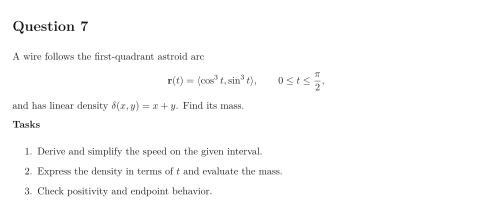
Original worksheet page 1: question and worked solution for 5-2-007
Show solutionHide solution

Question 7 – Solution

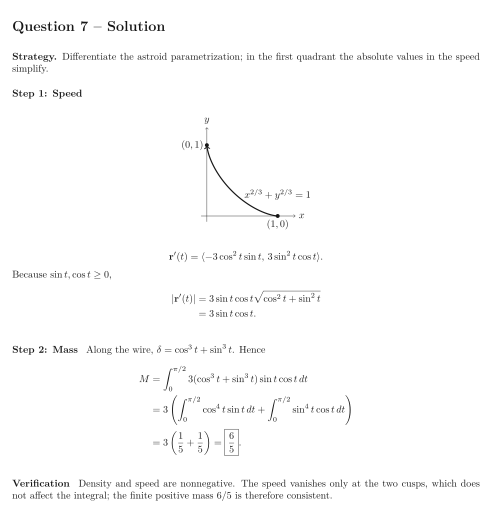
Strategy. Differentiate the astroid parametrization; in the first quadrant the absolute values in the speed simplify.

Step 1: Speed

See the diagram in the original worksheet below.

𝒓′(t)=⟨−3cos⁡2tsin⁡t,3sin⁡2tcos⁡t⟩.\mathbf r'(t)= \langle-3\cos^2t\sin t,\,3\sin^2t\cos t\rangle. Because sin⁡t,cos⁡t≥0\sin t,\cos t\ge 0, |𝒓′(t)|=3sin⁡tcos⁡tcos⁡2t+sin⁡2t=3sin⁡tcos⁡t.\begin{align*} |\mathbf r'(t)| &=3\sin t\cos t\sqrt{\cos^2t+\sin^2t}\\ &=3\sin t\cos t. \end{align*}

Step 2: Mass Along the wire, δ=cos⁡3t+sin⁡3t\delta=\cos^3t+\sin^3t. Hence M=∫0π/23(cos⁡3t+sin⁡3t)sin⁡tcos⁡tdt=3(∫0π/2cos⁡4tsintdt+∫0π/2sin⁡4tcostdt)=3(15+15)=65.\begin{align*} M&=\int_0^{\pi/2} 3(\cos^3t+\sin^3t)\sin t\cos t\,dt\\ &=3\left(\int_0^{\pi/2}\cos^4t\sin t\,dt +\int_0^{\pi/2}\sin^4t\cos t\,dt\right)\\ &=3\left(\frac 15+\frac 15\right)=\boxed{\frac 65}. \end{align*}

Verification Density and speed are nonnegative. The speed vanishes only at the two cusps, which does not affect the integral; the finite positive mass 6/56/5 is therefore consistent.

Original worksheet page 2: question and worked solution for 5-2-007

Original worksheet layout. Use Enlarge or open the PDF for a closer view.