Question 6
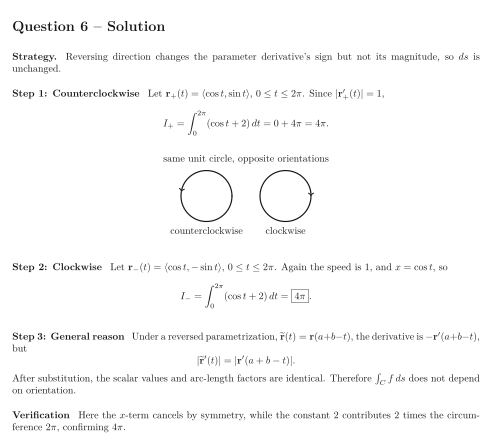
Let be the unit circle. Compute once with a counterclockwise parametrization and once with a clockwise parametrization.
Tasks
Write parametrizations for both orientations.
Show directly that both integrals have the same value.
Explain why every scalar line integral with respect to is orientation-independent.
Show solutionHide solution
Question 6 – Solution
Strategy. Reversing direction changes the parameter derivative’s sign but not its magnitude, so is unchanged.
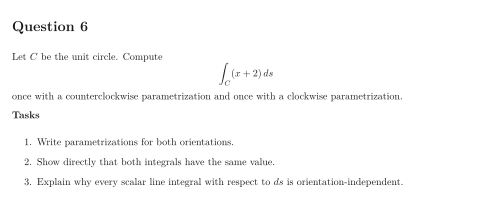
Step 1: Counterclockwise Let , . Since ,
See the diagram in the original worksheet below.
Step 2: Clockwise Let , . Again the speed is , and , so
Step 3: General reason Under a reversed parametrization, , the derivative is , but After substitution, the scalar values and arc-length factors are identical. Therefore does not depend on orientation.
Verification Here the -term cancels by symmetry, while the constant contributes times the circumference , confirming .