Vector Fields — Question 10

PDF ↗

Question 10

On the unit circle x2+y2=1x^2+y^2=1, consider 𝑭(x,y)=⟨2x−y,x+2y⟩.\mathbf F(x,y)=\langle 2x-y,x+2y\rangle.

Tasks

  1. Decompose 𝑭\mathbf F into outward radial and counterclockwise tangential components.

  2. Find its magnitude and its angle from the outward radial direction.

  3. Evaluate the decomposition at (0,1)(0,1) and determine whether the field has any zero away from the origin.
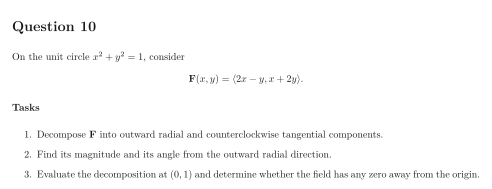
Original worksheet page 1: question and worked solution for 5-1-010
Show solutionHide solution

Question 10 – Solution

Strategy. Recognize the field as a fixed combination of the radial vector and its 90∘90^\circ counterclockwise rotation.

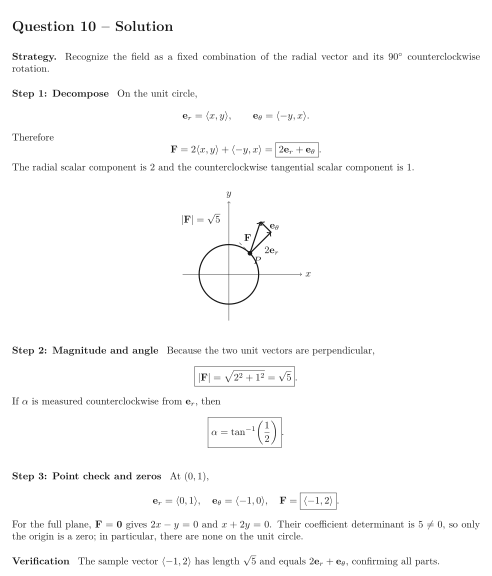
Step 1: Decompose On the unit circle, 𝒆r=⟨x,y⟩,𝒆θ=⟨−y,x⟩.\mathbf e_r=\langle x,y\rangle,\qquad \mathbf e_\theta=\langle-y,x\rangle. Therefore 𝑭=2⟨x,y⟩+⟨−y,x⟩=2𝒆r+𝒆θ.\mathbf F =2\langle x,y\rangle+\langle-y,x\rangle =\boxed{2\mathbf e_r+\mathbf e_\theta}. The radial scalar component is 22 and the counterclockwise tangential scalar component is 11.

See the diagram in the original worksheet below.

Step 2: Magnitude and angle Because the two unit vectors are perpendicular, |𝑭|=22+12=5.\boxed{|\mathbf F|=\sqrt{2^2+1^2}=\sqrt 5}. If α\alpha is measured counterclockwise from 𝒆r\mathbf e_r, then α=tan⁡−1(12).\boxed{\alpha=\tan^{-1}\!\left(\frac 12\right)}.

Step 3: Point check and zeros At (0,1)(0,1), 𝒆r=⟨0,1⟩,𝒆θ=⟨−1,0⟩,𝑭=⟨−1,2⟩.\mathbf e_r=\langle 0,1\rangle,\quad \mathbf e_\theta=\langle-1,0\rangle,\quad \mathbf F=\boxed{\langle-1,2\rangle}. For the full plane, 𝑭=𝟎\mathbf F=\mathbf 0 gives 2x−y=02x-y=0 and x+2y=0x+2y=0. Their coefficient determinant is 5≠05\ne 0, so only the origin is a zero; in particular, there are none on the unit circle.

Verification The sample vector ⟨−1,2⟩\langle-1,2\rangle has length 5\sqrt 5 and equals 2𝒆r+𝒆θ2\mathbf e_r+\mathbf e_\theta, confirming all parts.

Original worksheet page 2: question and worked solution for 5-1-010

Original worksheet layout. Use Enlarge or open the PDF for a closer view.