Vector Fields β€” Question 9

PDF β†—

Question 9

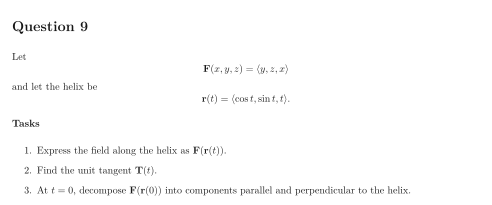
Let 𝑭(x,y,z)=⟨y,z,x⟩\mathbf F(x,y,z)=\langle y,z,x\rangle and let the helix be 𝒓(t)=⟨cos⁡t,sin⁡t,t⟩.\mathbf r(t)=\langle\cos t,\sin t,t\rangle.

Tasks

  1. Express the field along the helix as 𝑭(𝒓(t))\mathbf F(\mathbf r(t)).

  2. Find the unit tangent 𝑻(t)\mathbf T(t).

  3. At t=0t=0, decompose 𝑭(𝒓(0))\mathbf F(\mathbf r(0)) into components parallel and perpendicular to the helix.

Original worksheet page 1: question and worked solution for 5-1-009
Show solutionHide solution

Question 9 – Solution

Strategy. Substitute the curve into the field, then use vector projection onto the unit tangent.

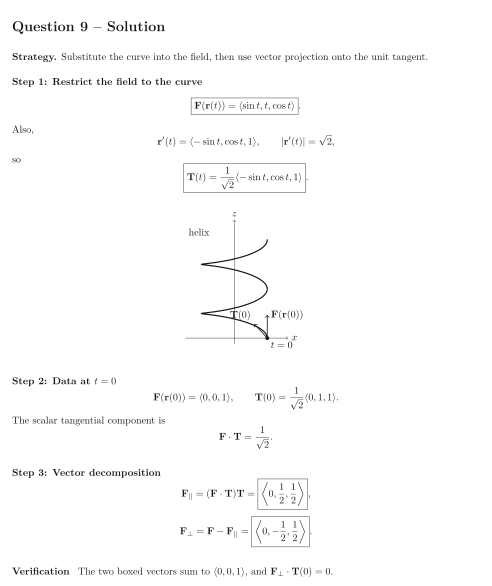
Step 1: Restrict the field to the curve 𝑭(𝒓(t))=⟨sin⁡t,t,cos⁡t⟩.\boxed{\mathbf F(\mathbf r(t))=\langle\sin t,t,\cos t\rangle}. Also, 𝒓′(t)=βŸ¨βˆ’sin⁡t,cos⁡t,1⟩,|𝒓′(t)|=2,\mathbf r'(t)=\langle-\sin t,\cos t,1\rangle, \qquad |\mathbf r'(t)|=\sqrt 2, so 𝑻(t)=12βŸ¨βˆ’sin⁡t,cos⁡t,1⟩.\boxed{\mathbf T(t)=\frac 1{\sqrt 2} \langle-\sin t,\cos t,1\rangle}.

See the diagram in the original worksheet below.

Step 2: Data at t=0t=0 𝑭(𝒓(0))=⟨0,0,1⟩,𝑻(0)=12⟨0,1,1⟩.\mathbf F(\mathbf r(0))=\langle 0,0,1\rangle,\qquad \mathbf T(0)=\frac 1{\sqrt 2}\langle 0,1,1\rangle. The scalar tangential component is 𝑭⋅𝑻=12.\mathbf F\cdot\mathbf T=\frac 1{\sqrt 2}.

Step 3: Vector decomposition 𝑭βˆ₯=(𝑭⋅𝑻)𝑻=⟨0,12,12⟩,\mathbf F_{\parallel}=(\mathbf F\cdot\mathbf T)\mathbf T =\boxed{\left\langle 0,\frac 12,\frac 12\right\rangle}, π‘­βŸ‚=π‘­βˆ’π‘­βˆ₯=⟨0,βˆ’12,12⟩.\mathbf F_{\perp}=\mathbf F-\mathbf F_{\parallel} =\boxed{\left\langle 0,-\frac 12,\frac 12\right\rangle}.

Verification The two boxed vectors sum to ⟨0,0,1⟩\langle 0,0,1\rangle, and π‘­βŸ‚β‹…π‘»(0)=0\mathbf F_{\perp}\cdot\mathbf T(0)=0.

Original worksheet page 2: question and worked solution for 5-1-009

Original worksheet layout. Use Enlarge or open the PDF for a closer view.