Double Integrals in Polar Coordinates — Question 10

PDF ↗

Question 10

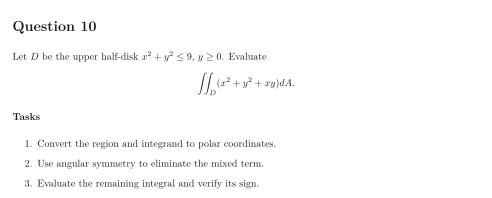
Let DD be the upper half-disk x2+y2≤9x^2+y^2\le 9, y≥0y\ge 0. Evaluate ∬D(x2+y2+xy)dA.\iint_D(x^2+y^2+xy)dA.

Tasks

  1. Convert the region and integrand to polar coordinates.

  2. Use angular symmetry to eliminate the mixed term.

  3. Evaluate the remaining integral and verify its sign.
Original worksheet page 1: question and worked solution for 4-4-010
Show solutionHide solution

Question 10 – Solution

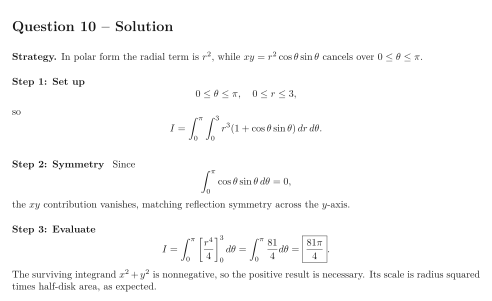
Strategy. In polar form the radial term is r2r^2, while xy=r2cos⁡θsin⁡θxy=r^2\cos\theta\sin\theta cancels over 0≤θ≤π0\le\theta\le\pi.

Step 1: Set up 0≤θ≤π,0≤r≤3,0\le\theta\le\pi,\quad 0\le r\le 3, so I=∫0π∫03r3(1+cos⁡θsin⁡θ)drdθ.I=\int_0^\pi\int_0^3r^3(1+\cos\theta\sin\theta)\,dr\,d\theta.

Step 2: Symmetry Since ∫0πcos⁡θsin⁡θdθ=0,\int_0^\pi\cos\theta\sin\theta\,d\theta=0, the xyxy contribution vanishes, matching reflection symmetry across the yy-axis.

Step 3: Evaluate I=∫0π[r44]03dθ=∫0π814dθ=81π4.I=\int_0^\pi\left[\frac{r^4}{4}\right]_0^3d\theta =\int_0^\pi\frac{81}{4}d\theta =\boxed{\frac{81\pi}{4}}. The surviving integrand x2+y2x^2+y^2 is nonnegative, so the positive result is necessary. Its scale is radius squared times half-disk area, as expected.
Original worksheet page 2: question and worked solution for 4-4-010

Original worksheet layout. Use Enlarge or open the PDF for a closer view.