Double Integrals in Polar Coordinates — Question 9

PDF ↗

Question 9

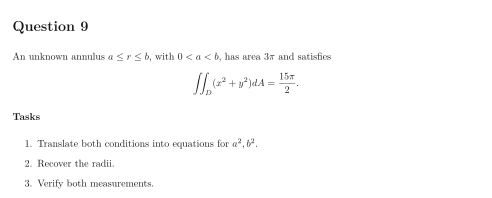
An unknown annulus a≤r≤ba\le r\le b, with 0<a<b0<a<b, has area 3π3\pi and satisfies ∬D(x2+y2)dA=15π2.\iint_D(x^2+y^2)dA=\frac{15\pi}{2}.

Tasks

  1. Translate both conditions into equations for a2,b2a^2,b^2.

  2. Recover the radii.

  3. Verify both measurements.

Original worksheet page 1: question and worked solution for 4-4-009
Show solutionHide solution

Question 9 – Solution

Strategy. Set A=a2A=a^2 and B=b2B=b^2; area gives their difference, while the radial moment gives a difference of squares.

See the diagram in the original worksheet below.

Step 1: Equations Area gives π(b2−a2)=3π,soB−A=3.\pi(b^2-a^2)=3\pi, \quad\text{so}\quad B-A=3. Also ∫02π∫abr3drdθ=π2(b4−a4)=15π2,\int_0^{2\pi}\int_a^b r^3dr\,d\theta =\frac\pi 2(b^4-a^4)=\frac{15\pi}{2}, so (B−A)(B+A)=15(B-A)(B+A)=15.

Step 2: Solve Since B−A=3B-A=3, we get B+A=5B+A=5. Therefore B=4B=4, A=1A=1, and positivity gives a=1,b=2.\boxed{a=1,\qquad b=2}.

Verification The area is π(4−1)=3π\pi(4-1)=3\pi, and the moment is π2(16−1)=15π/2\frac\pi 2(16-1)=15\pi/2. Both conditions hold exactly.

Original worksheet page 2: question and worked solution for 4-4-009

Original worksheet layout. Use Enlarge or open the PDF for a closer view.