Question 10
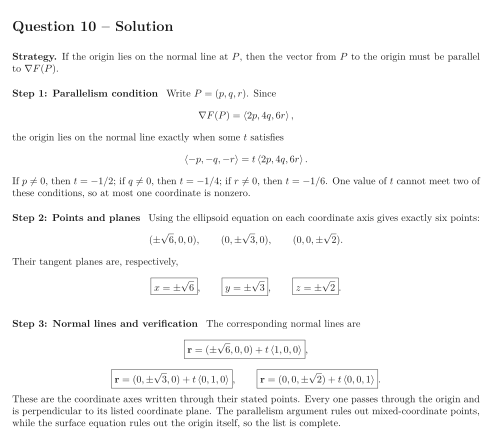
On the ellipsoid find every point at which the normal line passes through the origin.
Tasks
Derive the condition relating a point to its gradient.
Prove that at most one coordinate of such a point can be nonzero.
List all points, tangent planes, and normal lines, and verify completeness.
Show solutionHide solution
Question 10 – Solution
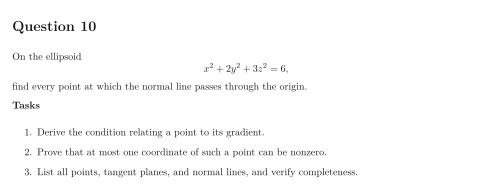
Strategy. If the origin lies on the normal line at , then the vector from to the origin must be parallel to .
Step 1: Parallelism condition Write . Since the origin lies on the normal line exactly when some satisfies If , then ; if , then ; if , then . One value of cannot meet two of these conditions, so at most one coordinate is nonzero.
Step 2: Points and planes Using the ellipsoid equation on each coordinate axis gives exactly six points: Their tangent planes are, respectively,
Step 3: Normal lines and verification The corresponding normal lines are These are the coordinate axes written through their stated points. Every one passes through the origin and is perpendicular to its listed coordinate plane. The parallelism argument rules out mixed-coordinate points, while the surface equation rules out the origin itself, so the list is complete.