Question 9
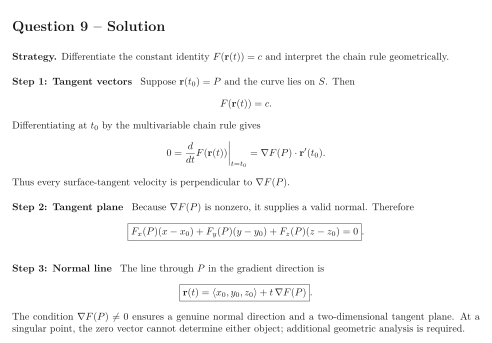
Let be a smooth level surface , and let be a point of with .
Tasks
For any differentiable curve on through , prove that its tangent at is perpendicular to .
Deduce the tangent-plane equation at .
Deduce the normal-line equation and explain the role of the regularity condition.
Show solutionHide solution
Question 9 – Solution
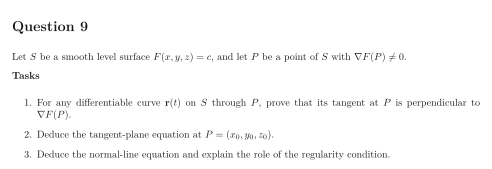
Strategy. Differentiate the constant identity and interpret the chain rule geometrically.
Step 1: Tangent vectors Suppose and the curve lies on . Then Differentiating at by the multivariable chain rule gives Thus every surface-tangent velocity is perpendicular to .
Step 2: Tangent plane Because is nonzero, it supplies a valid normal. Therefore
Step 3: Normal line The line through in the gradient direction is The condition ensures a genuine normal direction and a two-dimensional tangent plane. At a singular point, the zero vector cannot determine either object; additional geometric analysis is required.