Differentials — Question 7

PDF ↗

Question 7

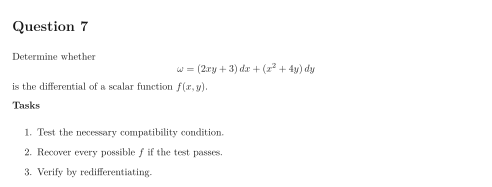
Determine whether ω=(2xy+3)dx+(x2+4y)dy\omega=(2xy+3)\,dx+(x^2+4y)\,dy is the differential of a scalar function f(x,y)f(x,y).

Tasks

  1. Test the necessary compatibility condition.

  2. Recover every possible ff if the test passes.

  3. Verify by redifferentiating.

Original worksheet page 1: question and worked solution for 2-5-007
Show solutionHide solution

Question 7 – Solution

Strategy. If df=Mdx+Ndydf=M\,dx+N\,dy, then My=NxM_y=N_x on a simply connected domain.

Step 1: Compatibility Here M=2xy+3,N=x2+4y.M=2xy+3,\qquad N=x^2+4y. Then My=2x=Nx,M_y=2x=N_x, so the form is compatible throughout ℝ2\mathbb R^2.

Step 2: Recover ff Integrate fx=Mf_x=M in xx: f=x2y+3x+C(y).f=x^2y+3x+C(y). Then fy=x2+C′(y)=x2+4y,f_y=x^2+C'(y)=x^2+4y, so C′(y)=4yC'(y)=4y and C(y)=2y2+C0C(y)=2y^2+C_0.

Result and verification f(x,y)=x2y+3x+2y2+C0.\boxed{f(x,y)=x^2y+3x+2y^2+C_0}. Indeed, differentiating gives df=(2xy+3)dx+(x2+4y)dydf=(2xy+3)\,dx+(x^2+4y)\,dy. The additive constant is invisible to the differential.

Original worksheet page 2: question and worked solution for 2-5-007

Original worksheet layout. Use Enlarge or open the PDF for a closer view.