Question 6
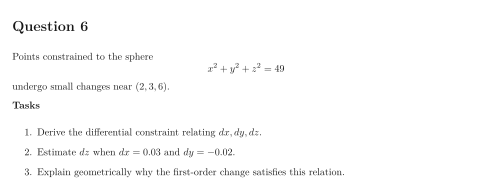
Points constrained to the sphere undergo small changes near .
Tasks
Derive the differential constraint relating .
Estimate when and .
Explain geometrically why the first-order change satisfies this relation.
Show solutionHide solution
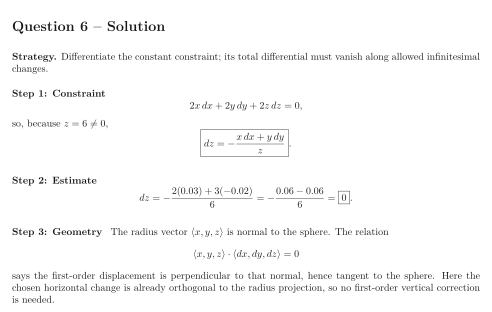
Question 6 – Solution
Strategy. Differentiate the constant constraint; its total differential must vanish along allowed infinitesimal changes.
Step 1: Constraint so, because ,
Step 2: Estimate
Step 3: Geometry The radius vector is normal to the sphere. The relation says the first-order displacement is perpendicular to that normal, hence tangent to the sphere. Here the chosen horizontal change is already orthogonal to the radius projection, so no first-order vertical correction is needed.