Higher Order Partial Derivatives — Question 8

PDF ↗

Question 8

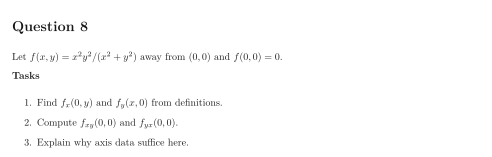
Let f(x,y)=x2y2/(x2+y2)f(x,y)=x^2y^2/(x^2+y^2) away from (0,0)(0,0) and f(0,0)=0f(0,0)=0.

Tasks

  1. Find fx(0,y)f_x(0,y) and fy(x,0)f_y(x,0) from definitions.

  2. Compute fxy(0,0)f_{xy}(0,0) and fyx(0,0)f_{yx}(0,0).

  3. Explain why axis data suffice here.

Original worksheet page 1: question and worked solution for 2-4-008
Show solutionHide solution

Question 8 – Solution

Strategy. Restrict first derivatives to an axis, then differentiate that restriction at zero.

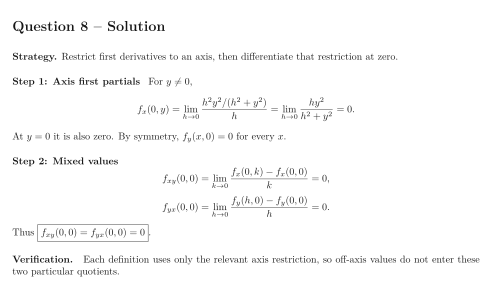
Step 1: Axis first partials For y≠0y\ne 0, fx(0,y)=limh→0h2y2/(h2+y2)h=limh→0hy2h2+y2=0.f_x(0,y)=\lim_{h\to 0}\frac{h^2y^2/(h^2+y^2)}h =\lim_{h\to 0}\frac{hy^2}{h^2+y^2}=0. At y=0y=0 it is also zero. By symmetry, fy(x,0)=0f_y(x,0)=0 for every xx.

Step 2: Mixed values fxy(0,0)=limk→0fx(0,k)−fx(0,0)k=0,f_{xy}(0,0)=\lim_{k\to 0}\frac{f_x(0,k)-f_x(0,0)}k=0, fyx(0,0)=limh→0fy(h,0)−fy(0,0)h=0.f_{yx}(0,0)=\lim_{h\to 0}\frac{f_y(h,0)-f_y(0,0)}h=0. Thus fxy(0,0)=fyx(0,0)=0\boxed{f_{xy}(0,0)=f_{yx}(0,0)=0}.

Verification. Each definition uses only the relevant axis restriction, so off-axis values do not enter these two particular quotients.
Original worksheet page 2: question and worked solution for 2-4-008

Original worksheet layout. Use Enlarge or open the PDF for a closer view.