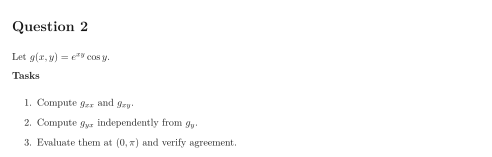
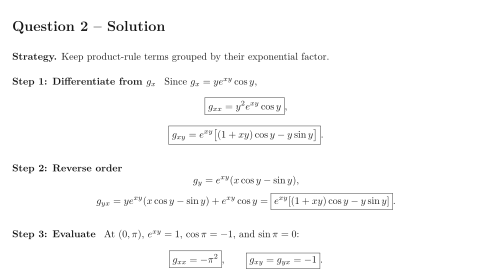
Question 2 Let g(x,y)=exycosyg(x,y)=e^{xy}\cos y. Tasks Compute gxxg_{xx} and gxyg_{xy}. Compute gyxg_{yx} independently from gyg_y. Evaluate them at (0,π)(0,\pi) and verify agreement. Show solutionHide solution+Question 2 – Solution Strategy. Keep product-rule terms grouped by their exponential factor. Step 1: Differentiate from gxg_x Since gx=yexycosyg_x=ye^{xy}\cos y, gxx=y2exycosy,\boxed{g_{xx}=y^2e^{xy}\cos y}, gxy=exy[(1+xy)cosy−ysiny].\boxed{g_{xy}=e^{xy}\bigl[(1+xy)\cos y-y\sin y\bigr]}. Step 2: Reverse order gy=exy(xcosy−siny),g_y=e^{xy}(x\cos y-\sin y), gyx=yexy(xcosy−siny)+exycosy=exy[(1+xy)cosy−ysiny].g_{yx}=ye^{xy}(x\cos y-\sin y)+e^{xy}\cos y =\boxed{e^{xy}[(1+xy)\cos y-y\sin y]}. Step 3: Evaluate At (0,π)(0,\pi), exy=1e^{xy}=1, cosπ=−1\cos\pi=-1, and sinπ=0\sin\pi=0: gxx=−π2,gxy=gyx=−1.\boxed{g_{xx}=-\pi^2},\qquad\boxed{g_{xy}=g_{yx}=-1}.