Partial Derivatives — Question 3

PDF ↗

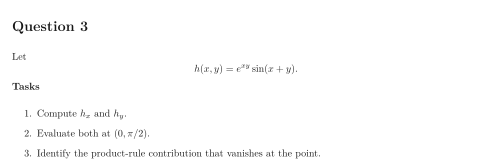
Question 3

Let h(x,y)=exysin⁡(x+y).h(x,y)=e^{xy}\sin(x+y). Tasks

  1. Compute hxh_x and hyh_y.

  2. Evaluate both at (0,π/2)(0,\pi/2).

  3. Identify the product-rule contribution that vanishes at the point.
Original worksheet page 1: question and worked solution for 2-2-003
Show solutionHide solution

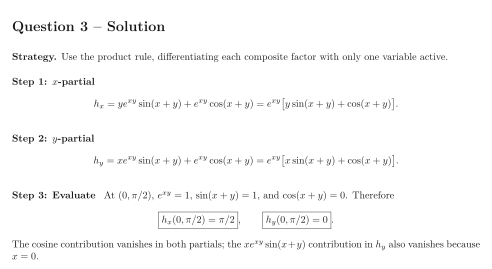
Question 3 – Solution

Strategy. Use the product rule, differentiating each composite factor with only one variable active.

Step 1: xx-partial hx=yexysin⁡(x+y)+exycos⁡(x+y)=exy[ysin⁡(x+y)+cos⁡(x+y)].h_x=ye^{xy}\sin(x+y)+e^{xy}\cos(x+y) =e^{xy}\bigl[y\sin(x+y)+\cos(x+y)\bigr].

Step 2: yy-partial hy=xexysin⁡(x+y)+exycos⁡(x+y)=exy[xsin⁡(x+y)+cos⁡(x+y)].h_y=xe^{xy}\sin(x+y)+e^{xy}\cos(x+y) =e^{xy}\bigl[x\sin(x+y)+\cos(x+y)\bigr].

Step 3: Evaluate At (0,π/2)(0,\pi/2), exy=1e^{xy}=1, sin⁡(x+y)=1\sin(x+y)=1, and cos⁡(x+y)=0\cos(x+y)=0. Therefore hx(0,π/2)=π/2,hy(0,π/2)=0.\boxed{h_x(0,\pi/2)=\pi/2},\qquad\boxed{h_y(0,\pi/2)=0}. The cosine contribution vanishes in both partials; the xexysin⁡(x+y)xe^{xy}\sin(x+y) contribution in hyh_y also vanishes because x=0x=0.

Original worksheet page 2: question and worked solution for 2-2-003

Original worksheet layout. Use Enlarge or open the PDF for a closer view.