Partial Derivatives — Question 2

PDF ↗

Question 2

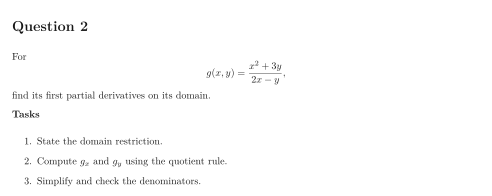
For g(x,y)=x2+3y2x−y,g(x,y)=\frac{x^2+3y}{2x-y}, find its first partial derivatives on its domain.

Tasks

  1. State the domain restriction.

  2. Compute gxg_x and gyg_y using the quotient rule.

  3. Simplify and check the denominators.

Original worksheet page 1: question and worked solution for 2-2-002
Show solutionHide solution

Question 2 – Solution

Strategy. Apply the one-variable quotient rule separately in each variable and preserve the original domain.

Step 1: Domain The function and its partial derivatives are defined where 2x−y≠0.\boxed{2x-y\ne 0}.

Step 2: xx-partial Holding yy fixed, gx=(2x)(2x−y)−2(x2+3y)(2x−y)2=2x2−2xy−6y(2x−y)2.\begin{align*} g_x&=\frac{(2x)(2x-y)-2(x^2+3y)}{(2x-y)^2}\\ &=\boxed{\frac{2x^2-2xy-6y}{(2x-y)^2}}. \end{align*}

Step 3: yy-partial Holding xx fixed, gy=3(2x−y)−(x2+3y)(−1)(2x−y)2=x2+6x(2x−y)2.\begin{align*} g_y&=\frac{3(2x-y)-(x^2+3y)(-1)}{(2x-y)^2}\\ &=\boxed{\frac{x^2+6x}{(2x-y)^2}}. \end{align*}

Verification. Both results have the squared quotient-rule denominator and remain restricted to 2x−y≠02x-y\ne 0; expanding each unsimplified numerator reproduces the displayed form.
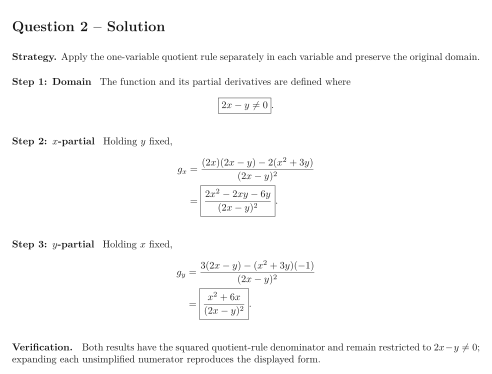
Original worksheet page 2: question and worked solution for 2-2-002

Original worksheet layout. Use Enlarge or open the PDF for a closer view.