Limits — Question 5

PDF ↗

Question 5

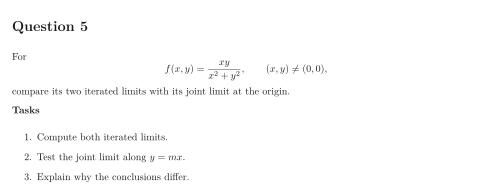
For f(x,y)=xyx2+y2,(x,y)≠(0,0),f(x,y)=\frac{xy}{x^2+y^2},\qquad (x,y)\ne(0,0), compare its two iterated limits with its joint limit at the origin.

Tasks

  1. Compute both iterated limits.

  2. Test the joint limit along y=mxy=mx.

  3. Explain why the conclusions differ.

Original worksheet page 1: question and worked solution for 2-1-005
Show solutionHide solution

Question 5 – Solution

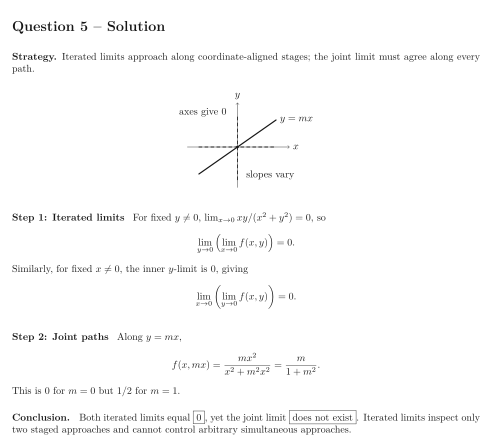
Strategy. Iterated limits approach along coordinate-aligned stages; the joint limit must agree along every path.

See the diagram in the original worksheet below.

Step 1: Iterated limits For fixed y≠0y\ne 0, lim⁡x→0xy/(x2+y2)=0\lim_{x\to 0}xy/(x^2+y^2)=0, so limy→0(limx→0f(x,y))=0.\lim_{y\to 0}\left(\lim_{x\to 0}f(x,y)\right)=0. Similarly, for fixed x≠0x\ne 0, the inner yy-limit is 00, giving limx→0(limy→0f(x,y))=0.\lim_{x\to 0}\left(\lim_{y\to 0}f(x,y)\right)=0.

Step 2: Joint paths Along y=mxy=mx, f(x,mx)=mx2x2+m2x2=m1+m2.f(x,mx)=\frac{mx^2}{x^2+m^2x^2}=\frac{m}{1+m^2}. This is 00 for m=0m=0 but 1/21/2 for m=1m=1.

Conclusion. Both iterated limits equal 0\boxed{0}, yet the joint limit does not exist\boxed{\text{does not exist}}. Iterated limits inspect only two staged approaches and cannot control arbitrary simultaneous approaches.
Original worksheet page 2: question and worked solution for 2-1-005

Original worksheet layout. Use Enlarge or open the PDF for a closer view.