Limits — Question 4

PDF ↗

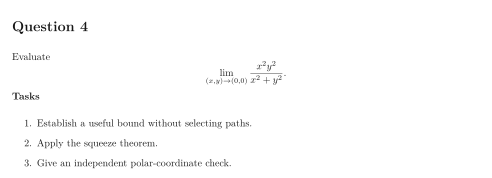
Question 4

Evaluate lim(x,y)→(0,0)x2y2x2+y2.\lim_{(x,y)\to(0,0)}\frac{x^2y^2}{x^2+y^2}. Tasks

  1. Establish a useful bound without selecting paths.

  2. Apply the squeeze theorem.

  3. Give an independent polar-coordinate check.
Original worksheet page 1: question and worked solution for 2-1-004
Show solutionHide solution

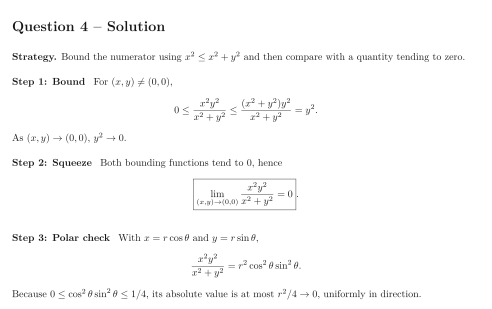
Question 4 – Solution

Strategy. Bound the numerator using x2≤x2+y2x^2\le x^2+y^2 and then compare with a quantity tending to zero.

Step 1: Bound For (x,y)≠(0,0)(x,y)\ne(0,0), 0≤x2y2x2+y2≤(x2+y2)y2x2+y2=y2.0\le\frac{x^2y^2}{x^2+y^2}\le\frac{(x^2+y^2)y^2}{x^2+y^2}=y^2. As (x,y)→(0,0)(x,y)\to(0,0), y2→0y^2\to 0.

Step 2: Squeeze Both bounding functions tend to 00, hence lim(x,y)→(0,0)x2y2x2+y2=0.\boxed{\displaystyle \lim_{(x,y)\to(0,0)}\frac{x^2y^2}{x^2+y^2}=0}.

Step 3: Polar check With x=rcos⁡θx=r\cos\theta and y=rsin⁡θy=r\sin\theta, x2y2x2+y2=r2cos⁡2θsin⁡2θ.\frac{x^2y^2}{x^2+y^2}=r^2\cos^2\theta\sin^2\theta. Because 0≤cos⁡2θsin⁡2θ≤1/40\le\cos^2\theta\sin^2\theta\le 1/4, its absolute value is at most r2/4→0r^2/4\to 0, uniformly in direction.

Original worksheet page 2: question and worked solution for 2-1-004

Original worksheet layout. Use Enlarge or open the PDF for a closer view.