Tangent, Normal and Binormal Vectors β€” Question 7

PDF β†—

Question 7

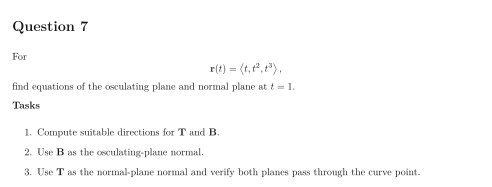
For 𝒓(t)=⟨t,t2,t3⟩,\mathbf r(t)=\left\langle t,t^2,t^3\right\rangle, find equations of the osculating plane and normal plane at t=1t=1.

Tasks

  1. Compute suitable directions for 𝑻\mathbf T and 𝑩\mathbf B.

  2. Use 𝑩\mathbf B as the osculating-plane normal.

  3. Use 𝑻\mathbf T as the normal-plane normal and verify both planes pass through the curve point.
Original worksheet page 1: question and worked solution for 1-8-007
Show solutionHide solution

Question 7 – Solution

Strategy. The osculating plane is spanned by 𝑻\mathbf T and 𝑡\mathbf N, so its normal is 𝑩\mathbf B. The normal plane is perpendicular to 𝑻\mathbf T.

See the diagram in the original worksheet below.

Step 1: Point and tangent direction P=𝒓(1)=(1,1,1),𝒓′(1)=⟨1,2,3⟩.P=\mathbf r(1)=(1,1,1),\qquad \mathbf r'(1)=\left\langle 1,2,3\right\rangle. We may use ⟨1,2,3⟩\left\langle 1,2,3\right\rangle as the normal vector of the normal plane.

Step 2: Binormal direction 𝒓″(t)=⟨0,2,6t⟩,𝒓″(1)=⟨0,2,6⟩.\mathbf r''(t)=\left\langle 0,2,6t\right\rangle,\qquad \mathbf r''(1)=\left\langle 0,2,6\right\rangle. Then 𝒓′(1)×𝒓″(1)=⟨1,2,3βŸ©Γ—βŸ¨0,2,6⟩=⟨6,βˆ’6,2⟩=2⟨3,βˆ’3,1⟩.\mathbf r'(1)\times\mathbf r''(1) =\left\langle 1,2,3\right\rangle\times\left\langle 0,2,6\right\rangle=\left\langle 6,-6,2\right\rangle=2\left\langle 3,-3,1\right\rangle. Hence an osculating-plane normal is ⟨3,βˆ’3,1⟩\left\langle 3,-3,1\right\rangle.

Step 3: Plane equations Through P=(1,1,1)P=(1,1,1), the osculating plane is 3(xβˆ’1)βˆ’3(yβˆ’1)+(zβˆ’1)=0β‡’3xβˆ’3y+z=1.3(x-1)-3(y-1)+(z-1)=0 \quad\Longrightarrow\quad \boxed{3x-3y+z=1}. The normal plane is (xβˆ’1)+2(yβˆ’1)+3(zβˆ’1)=0β‡’x+2y+3z=6.(x-1)+2(y-1)+3(z-1)=0 \quad\Longrightarrow\quad \boxed{x+2y+3z=6}. Substitution of (1,1,1)(1,1,1) verifies both equations, and their normals have the required Frenet directions.

Original worksheet page 2: question and worked solution for 1-8-007

Original worksheet layout. Use Enlarge or open the PDF for a closer view.