Tangent, Normal and Binormal Vectors β€” Question 6

PDF β†—

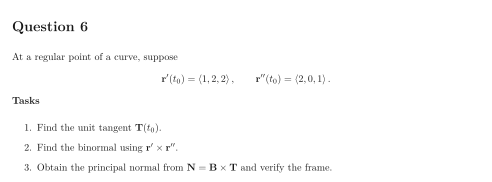
Question 6

At a regular point of a curve, suppose 𝒓′(t0)=⟨1,2,2⟩,𝒓″(t0)=⟨2,0,1⟩.\mathbf r'(t_0)=\left\langle 1,2,2\right\rangle,\qquad \mathbf r''(t_0)=\left\langle 2,0,1\right\rangle. Tasks

  1. Find the unit tangent 𝑻(t0)\mathbf T(t_0).

  2. Find the binormal using 𝒓′×𝒓″\mathbf r'\times\mathbf r''.

  3. Obtain the principal normal from 𝑡=𝑩×𝑻\mathbf N=\mathbf B\times\mathbf T and verify the frame.

Original worksheet page 1: question and worked solution for 1-8-006
Show solutionHide solution

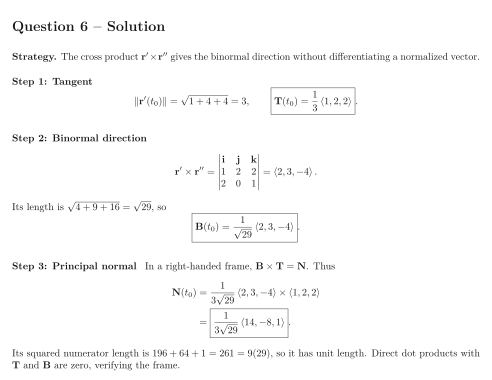
Question 6 – Solution

Strategy. The cross product 𝒓′×𝒓″\mathbf r'\times\mathbf r'' gives the binormal direction without differentiating a normalized vector.

Step 1: Tangent βˆ₯𝒓′(t0)βˆ₯=1+4+4=3,𝑻(t0)=13⟨1,2,2⟩.\|\mathbf r'(t_0)\|=\sqrt{1+4+4}=3, \qquad \boxed{\mathbf T(t_0)=\frac 13\left\langle 1,2,2\right\rangle}.

Step 2: Binormal direction 𝒓′×𝒓″=βˆ£π’Šπ’‹π’Œ122201∣=⟨2,3,βˆ’4⟩.\begin{align*} \mathbf r'\times\mathbf r'' &=\begin{vmatrix}\mathbf i&\mathbf j&\mathbf k\\1&2&2\\2&0&1\end{vmatrix} =\left\langle 2,3,-4\right\rangle. \end{align*} Its length is 4+9+16=29\sqrt{4+9+16}=\sqrt{29}, so 𝑩(t0)=129⟨2,3,βˆ’4⟩.\boxed{\mathbf B(t_0)=\frac 1{\sqrt{29}}\left\langle 2,3,-4\right\rangle}.

Step 3: Principal normal In a right-handed frame, 𝑩×𝑻=𝑡\mathbf B\times\mathbf T=\mathbf N. Thus 𝑡(t0)=1329⟨2,3,βˆ’4βŸ©Γ—βŸ¨1,2,2⟩=1329⟨14,βˆ’8,1⟩.\begin{align*} \mathbf N(t_0) &=\frac 1{3\sqrt{29}}\left\langle 2,3,-4\right\rangle\times\left\langle 1,2,2\right\rangle\\ &=\boxed{\frac 1{3\sqrt{29}}\left\langle 14,-8,1\right\rangle}. \end{align*} Its squared numerator length is 196+64+1=261=9(29)196+64+1=261=9(29), so it has unit length. Direct dot products with 𝑻\mathbf T and 𝑩\mathbf B are zero, verifying the frame.

Original worksheet page 2: question and worked solution for 1-8-006

Original worksheet layout. Use Enlarge or open the PDF for a closer view.