Question 4
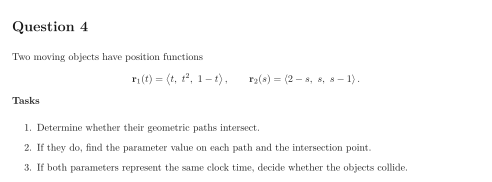
Two moving objects have position functions Tasks
Determine whether their geometric paths intersect.
If they do, find the parameter value on each path and the intersection point.
If both parameters represent the same clock time, decide whether the objects collide.
Show solutionHide solution
Question 4 – Solution
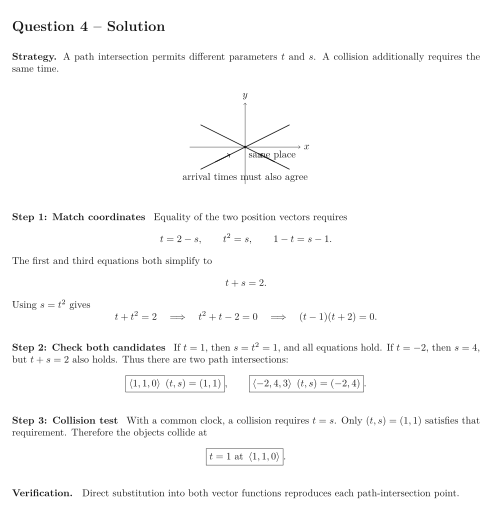
Strategy. A path intersection permits different parameters and . A collision additionally requires the same time.
See the diagram in the original worksheet below.
Step 1: Match coordinates Equality of the two position vectors requires The first and third equations both simplify to Using gives
Step 2: Check both candidates If , then , and all equations hold. If , then , but also holds. Thus there are two path intersections:
Step 3: Collision test With a common clock, a collision requires . Only satisfies that requirement. Therefore the objects collide at
Verification. Direct substitution into both vector functions reproduces each path-intersection point.