Question 3
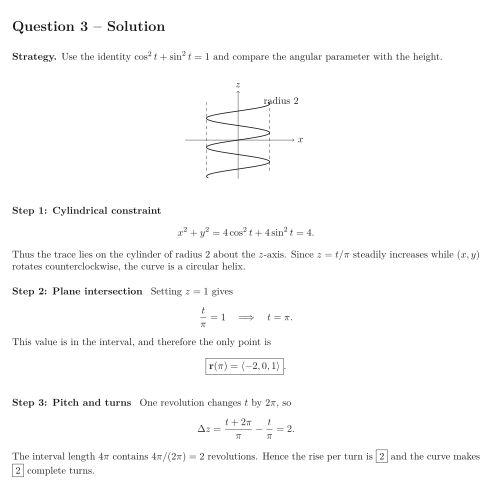
A particle follows Without calculus:
Describe the trace geometrically and state its axis and radius.
Find every point where the particle meets the plane .
Determine the vertical rise during one complete revolution and the total number of revolutions.
Show solutionHide solution
Question 3 – Solution
Strategy. Use the identity and compare the angular parameter with the height.
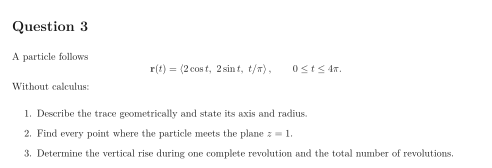
See the diagram in the original worksheet below.
Step 1: Cylindrical constraint Thus the trace lies on the cylinder of radius about the -axis. Since steadily increases while rotates counterclockwise, the curve is a circular helix.
Step 2: Plane intersection Setting gives This value is in the interval, and therefore the only point is
Step 3: Pitch and turns One revolution changes by , so The interval length contains revolutions. Hence the rise per turn is and the curve makes complete turns.