Equations of Planes — Question 4

PDF ↗

Question 4

Consider the planes Π1:x+y−z=2,Π2:2x−y+z=1.\Pi_1:x+y-z=2,\qquad \Pi_2:2x-y+z=1. Tasks

  1. Find a vector and parametric equation for their line of intersection.

  2. Find the dihedral angle between the planes.

  3. Verify the line equation in both plane equations.
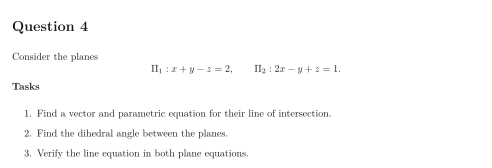
Original worksheet page 1: question and worked solution for 1-3-004
Show solutionHide solution

Question 4 – Solution

Strategy The intersection direction is perpendicular to both normals. Solve the two plane equations for one point and one free parameter.

See the diagram in the original worksheet below.

Step 1: Solve simultaneously Add the equations: (x+y−z)+(2x−y+z)=2+1⇒3x=3⇒x=1.(x+y-z)+(2x-y+z)=2+1\Longrightarrow 3x=3\Longrightarrow x=1. Substitute x=1x=1 into x+y−z=2x+y-z=2: 1+y−z=2⇒y=1+z.1+y-z=2\Longrightarrow y=1+z. Let the free coordinate be z=tz=t. Then y=1+ty=1+t, so r→=⟨1,1,0⟩+t⟨0,1,1⟩.\boxed{\vec r=\left\langle 1,1,0\right\rangle+t\left\langle 0,1,1\right\rangle}.

Step 2: Confirm the direction The normals are n→1=⟨1,1,−1⟩\vec n_1=\left\langle 1,1,-1\right\rangle and n→2=⟨2,−1,1⟩\vec n_2=\left\langle 2,-1,1\right\rangle. Their cross product is ⟨0,−3,−3⟩\left\langle 0,-3,-3\right\rangle, parallel to ⟨0,1,1⟩\left\langle 0,1,1\right\rangle.

Step 3: Angle Compute n→1⋅n→2=2−1−1=0\vec n_1\cdot\vec n_2=2-1-1=0. Therefore cos⁡θ=|n→1⋅n→2|∥n→1∥∥n→2∥=0,θ=90∘.\cos\theta=\frac{|\vec n_1\cdot\vec n_2|}{\|\vec n_1\|\|\vec n_2\|}=0, \qquad \boxed{\theta=90^\circ}.

Verification Substitution of (1,1+t,t)(1,1+t,t) gives 22 in Π1\Pi_1 and 11 in Π2\Pi_2 for every tt.

Original worksheet page 2: question and worked solution for 1-3-004

Original worksheet layout. Use Enlarge or open the PDF for a closer view.