Equations of Planes — Question 3

PDF ↗

Question 3

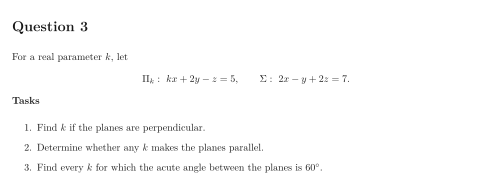
For a real parameter kk, let Πk:kx+2y−z=5,Σ:2x−y+2z=7.\Pi_k:\ kx+2y-z=5,\qquad \Sigma:\ 2x-y+2z=7. Tasks

  1. Find kk if the planes are perpendicular.

  2. Determine whether any kk makes the planes parallel.

  3. Find every kk for which the acute angle between the planes is 60∘60^\circ.

Original worksheet page 1: question and worked solution for 1-3-003
Show solutionHide solution

Question 3 – Solution

Strategy Plane orientation is controlled by the normals n→k=⟨k,2,−1⟩\vec n_k=\left\langle k,2,-1\right\rangle and m→=⟨2,−1,2⟩\vec m=\left\langle 2,-1,2\right\rangle.

See the diagram in the original worksheet below.

Step 1: Perpendicularity Calculate n→k⋅m→=k(2)+2(−1)+(−1)(2)=2k−4.\vec n_k\cdot\vec m=k(2)+2(-1)+(-1)(2)=2k-4. Perpendicular normals require 2k−4=02k-4=0, hence k=2\boxed{k=2}.

Step 2: Parallelism Parallelism would require ⟨k,2,−1⟩=λ⟨2,−1,2⟩\left\langle k,2,-1\right\rangle=\lambda\left\langle 2,-1,2\right\rangle. From 2=−λ2=-\lambda, λ=−2\lambda=-2; but the third coordinate would require −1=2(−2)=−4-1=2(-2)=-4, a contradiction. Hence .

Step 3: The 60∘60^\circ condition The angle formula gives |2k−4|3k2+5=12.\frac{|2k-4|}{3\sqrt{k^2+5}}=\frac 12. Cross-multiply and square: 2|2k−4|=3k2+5⇒16(k−2)2=9(k2+5).2|2k-4|=3\sqrt{k^2+5}\Longrightarrow 16(k-2)^2=9(k^2+5). Expanding gives 16k2−64k+64=9k2+4516k^2-64k+64=9k^2+45, so 7k2−64k+19=0.7k^2-64k+19=0. The quadratic formula yields k=64±642−4(7)(19)14=64±181114,k=\frac{64\pm\sqrt{64^2-4(7)(19)}}{14} =\frac{64\pm 18\sqrt{11}}{14}, and therefore k=32±9117.\boxed{k=\frac{32\pm 9\sqrt{11}}7}.

Verification Neither root makes the original denominator zero, and substitution into the unsquared equation gives the positive value 1/21/2, so no extraneous root remains.

Original worksheet page 2: question and worked solution for 1-3-003

Original worksheet layout. Use Enlarge or open the PDF for a closer view.