Equations of Lines — Question 5

PDF ↗

Question 5

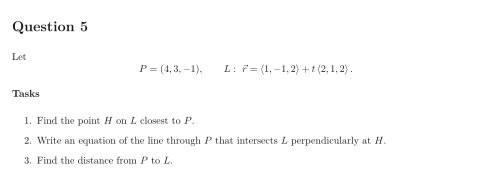
Let P=(4,3,−1),L:r→=⟨1,−1,2⟩+t⟨2,1,2⟩.P=(4,3,-1),\qquad L:\ \vec r=\left\langle 1,-1,2\right\rangle+t\left\langle 2,1,2\right\rangle.

Tasks

  1. Find the point HH on LL closest to PP.

  2. Write an equation of the line through PP that intersects LL perpendicularly at HH.

  3. Find the distance from PP to LL.

Original worksheet page 1: question and worked solution for 1-2-005
Show solutionHide solution

Question 5 – Solution

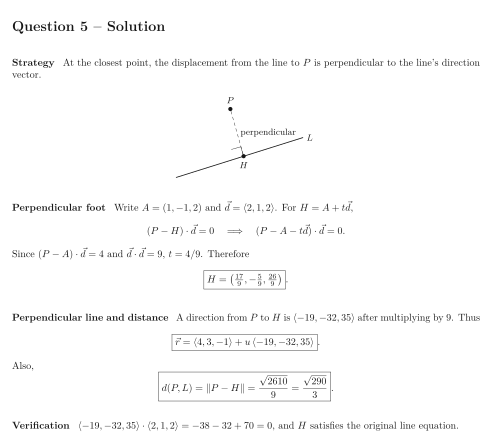
Strategy At the closest point, the displacement from the line to PP is perpendicular to the line’s direction vector.

See the diagram in the original worksheet below.

Perpendicular foot Write A=(1,−1,2)A=(1,-1,2) and d→=⟨2,1,2⟩\vec d=\left\langle 2,1,2\right\rangle. For H=A+td→H=A+t\vec d, (P−H)⋅d→=0⇒(P−A−td→)⋅d→=0.(P-H)\cdot\vec d=0\quad\Longrightarrow\quad (P-A-t\vec d)\cdot\vec d=0. Since (P−A)⋅d→=4(P-A)\cdot\vec d=4 and d→⋅d→=9\vec d\cdot\vec d=9, t=4/9t=4/9. Therefore H=(179,−59,269).\boxed{H=\left(\tfrac{17}{9},-\tfrac 59,\tfrac{26}{9}\right)}.

Perpendicular line and distance A direction from PP to HH is ⟨−19,−32,35⟩\left\langle -19,-32,35\right\rangle after multiplying by 99. Thus r→=⟨4,3,−1⟩+u⟨−19,−32,35⟩.\boxed{\vec r=\left\langle 4,3,-1\right\rangle+u\left\langle -19,-32,35\right\rangle}. Also, d(P,L)=∥P−H∥=26109=2903.\boxed{d(P,L)=\|P-H\|=\frac{\sqrt{2610}}9=\frac{\sqrt{290}}3}.

Verification ⟨−19,−32,35⟩⋅⟨2,1,2⟩=−38−32+70=0\left\langle -19,-32,35\right\rangle\cdot\left\langle 2,1,2\right\rangle=-38-32+70=0, and HH satisfies the original line equation.

Original worksheet page 2: question and worked solution for 1-2-005

Original worksheet layout. Use Enlarge or open the PDF for a closer view.