Equations of Lines — Question 2

PDF ↗

Question 2

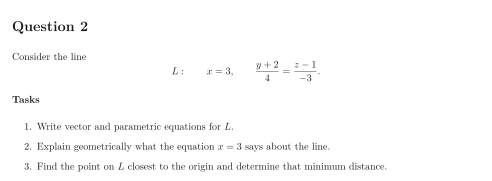
Consider the line L:x=3,y+24=z−1−3.L:\qquad x=3,\qquad \frac{y+2}{4}=\frac{z-1}{-3}.

Tasks

  1. Write vector and parametric equations for LL.

  2. Explain geometrically what the equation x=3x=3 says about the line.

  3. Find the point on LL closest to the origin and determine that minimum distance.
Original worksheet page 1: question and worked solution for 1-2-002
Show solutionHide solution

Question 2 – Solution

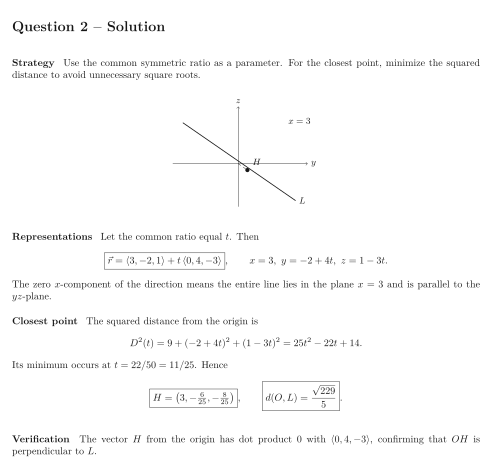
Strategy Use the common symmetric ratio as a parameter. For the closest point, minimize the squared distance to avoid unnecessary square roots.

See the diagram in the original worksheet below.

Representations Let the common ratio equal tt. Then r→=⟨3,−2,1⟩+t⟨0,4,−3⟩,x=3,y=−2+4t,z=1−3t.\boxed{\vec r=\left\langle 3,-2,1\right\rangle+t\left\langle 0,4,-3\right\rangle},\qquad x=3,\ y=-2+4t,\ z=1-3t. The zero xx-component of the direction means the entire line lies in the plane x=3x=3 and is parallel to the yzyz-plane.

Closest point The squared distance from the origin is D2(t)=9+(−2+4t)2+(1−3t)2=25t2−22t+14.D^2(t)=9+(-2+4t)^2+(1-3t)^2=25t^2-22t+14. Its minimum occurs at t=22/50=11/25t=22/50=11/25. Hence H=(3,−625,−825),d(O,L)=2295.\boxed{H=\left(3,-\tfrac 6{25},-\tfrac 8{25}\right)},\qquad \boxed{d(O,L)=\frac{\sqrt{229}}5}.

Verification The vector HH from the origin has dot product 00 with ⟨0,4,−3⟩\left\langle 0,4,-3\right\rangle, confirming that OHOH is perpendicular to LL.

Original worksheet page 2: question and worked solution for 1-2-002

Original worksheet layout. Use Enlarge or open the PDF for a closer view.