Curvature — Question 9

PDF ↗

Question 9

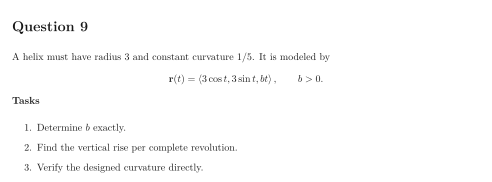
A helix must have radius 33 and constant curvature 1/51/5. It is modeled by 𝒓(t)=⟨3cost,3sint,bt⟩,b>0.\mathbf r(t)=\left\langle 3\cos t,3\sin t,bt\right\rangle,\qquad b>0. Tasks

  1. Determine bb exactly.

  2. Find the vertical rise per complete revolution.

  3. Verify the designed curvature directly.
Original worksheet page 1: question and worked solution for 1-10-009
Show solutionHide solution

Question 9 – Solution

Strategy. Use the helix curvature formula and then translate parameter change into vertical rise.

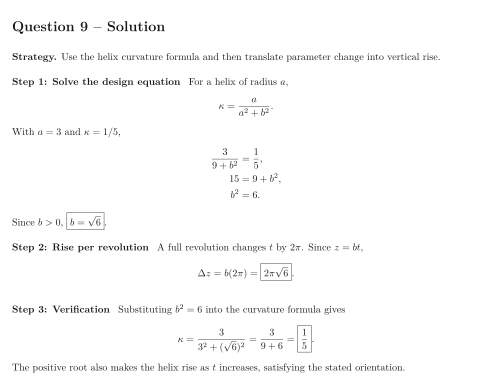
Step 1: Solve the design equation For a helix of radius aa, κ=aa2+b2.\kappa=\frac{a}{a^2+b^2}. With a=3a=3 and κ=1/5\kappa=1/5, 39+b2=15,15=9+b2,b2=6.\begin{align*} \frac 3{9+b^2}&=\frac 15,\\ 15&=9+b^2,\\ b^2&=6. \end{align*} Since b>0b>0, b=6\boxed{b=\sqrt 6}.

Step 2: Rise per revolution A full revolution changes tt by 2π2\pi. Since z=btz=bt, Δz=b(2π)=2π6.\Delta z=b(2\pi)=\boxed{2\pi\sqrt 6}.

Step 3: Verification Substituting b2=6b^2=6 into the curvature formula gives κ=332+(6)2=39+6=15.\kappa=\frac 3{3^2+(\sqrt 6)^2} =\frac 3{9+6}=\boxed{\frac 15}. The positive root also makes the helix rise as tt increases, satisfying the stated orientation.
Original worksheet page 2: question and worked solution for 1-10-009

Original worksheet layout. Use Enlarge or open the PDF for a closer view.