Curvature — Question 8

PDF ↗

Question 8

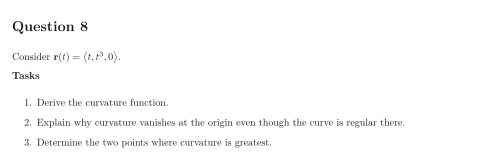
Consider 𝒓(t)=⟨t,t3,0⟩\mathbf r(t)=\left\langle t,t^3,0\right\rangle.

Tasks

  1. Derive the curvature function.

  2. Explain why curvature vanishes at the origin even though the curve is regular there.

  3. Determine the two points where curvature is greatest.
Original worksheet page 1: question and worked solution for 1-10-008
Show solutionHide solution

Question 8 – Solution

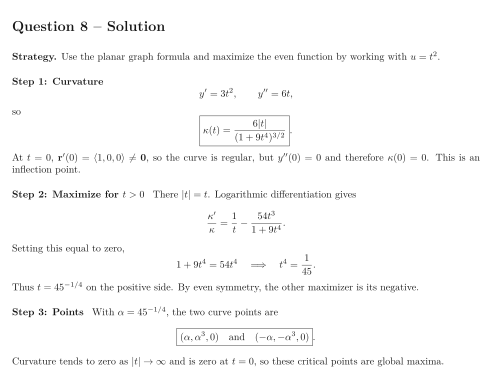
Strategy. Use the planar graph formula and maximize the even function by working with u=t2u=t^2.

Step 1: Curvature y′=3t2,y″=6t,y'=3t^2,\qquad y''=6t, so κ(t)=6|t|(1+9t4)3/2.\boxed{\kappa(t)=\frac{6|t|}{(1+9t^4)^{3/2}}}. At t=0t=0, 𝒓′(0)=⟨1,0,0⟩≠𝟎\mathbf r'(0)=\left\langle 1,0,0\right\rangle\ne\mathbf 0, so the curve is regular, but y″(0)=0y''(0)=0 and therefore κ(0)=0\kappa(0)=0. This is an inflection point.

Step 2: Maximize for t>0t>0 There |t|=t|t|=t. Logarithmic differentiation gives κ′κ=1t−54t31+9t4.\frac{\kappa'}{\kappa}=\frac 1t-\frac{54t^3}{1+9t^4}. Setting this equal to zero, 1+9t4=54t4⇒t4=145.1+9t^4=54t^4 \quad\Longrightarrow\quad t^4=\frac 1{45}. Thus t=45−1/4t=45^{-1/4} on the positive side. By even symmetry, the other maximizer is its negative.

Step 3: Points With α=45−1/4\alpha=45^{-1/4}, the two curve points are (α,α3,0)and(−α,−α3,0).\boxed{(\alpha,\alpha^3,0)\quad\text{and}\quad(-\alpha,-\alpha^3,0)}. Curvature tends to zero as |t|→∞|t|\to\infty and is zero at t=0t=0, so these critical points are global maxima.
Original worksheet page 2: question and worked solution for 1-10-008

Original worksheet layout. Use Enlarge or open the PDF for a closer view.