Tangent, Normal and Binormal Vectors — Question 4

PDF ↗

Question 4

A regular curve r→(t)\vec r(t) with nonzero curvature is reparameterized with the opposite orientation by q→(u)=r→(ϕ(u))\vec q(u)=\vec r(\phi(u)), where ϕ′(u)<0\phi'(u)<0. Determine how 𝑻,𝑵,𝑩\mathbf T,\mathbf N,\mathbf B change. Give a geometric explanation.

Original worksheet page 1: question and worked solution for 6-8-004
Show solutionHide solution

Question 4 – Solution

Strategy Apply the chain rule and track the sign introduced by the decreasing parameter.

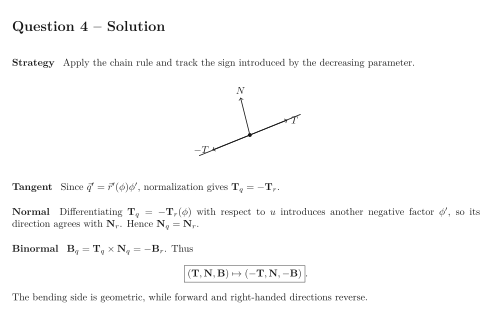
See the diagram in the original worksheet below.

Tangent Since q→′=r→′(ϕ)ϕ′\vec q'=\vec r'(\phi)\phi', normalization gives 𝑻q=−𝑻r\mathbf T_q=-\mathbf T_r.

Normal Differentiating 𝑻q=−𝑻r(ϕ)\mathbf T_q=-\mathbf T_r(\phi) with respect to uu introduces another negative factor ϕ′\phi', so its direction agrees with 𝑵r\mathbf N_r. Hence 𝑵q=𝑵r\mathbf N_q=\mathbf N_r.

Binormal 𝑩q=𝑻q×𝑵q=−𝑩r\mathbf B_q=\mathbf T_q\times\mathbf N_q=-\mathbf B_r. Thus (𝑻,𝑵,𝑩)↦(−𝑻,𝑵,−𝑩).\boxed{(\mathbf T,\mathbf N,\mathbf B)\mapsto(-\mathbf T,\mathbf N,-\mathbf B)}. The bending side is geometric, while forward and right-handed directions reverse.
Original worksheet page 2: question and worked solution for 6-8-004

Original worksheet layout. Use Enlarge or open the PDF for a closer view.
